Best Circular Saws for Women: Lightweight, Safe Power Tools for Home Projects
Finding a circular saw that pairs safety, lightness, and reliability can empower more women to tackle DIY projects confidently. This guide highlights five user-friendly options that balance power with ergonomic design, making cutting tasks smoother and less fatiguing. Each pick includes features focused on precision, ease of use, and portability to support a variety of common home projects, from picture framing to small woodworking tasks.
| Product | Brand |
|---|---|
| Skil 5080-01 13-Amp 7-1/4″ Circular Saw | Skil |
| Extbtfor Power Circular Saw, Mini 4.8A | Extbtfor |
| RYOBI 18V 5-1/2″ Circular Saw | RYOBI |
| Genesis Mini Circular Saw 4.0 Amp | Genesis |
| Seesii Mini Circular Saw with Laser Guide | Seesii |
Skil 5080-01: Balanced Power, Lower Fatigue

The Skil 5080-01 offers a 13-amp motor with a 7-1/4″ blade, delivering steady power for common woodworking tasks. A 51-degree bevel with positive stops supports versatile cuts while keeping the tool manageable for prolonged use. At a reduced weight versus earlier SKIL models, it helps minimize user fatigue during longer sessions. Suitable for framing, decking, and general carpentry, this saw provides reliable performance in a familiar, widely available package.
Extbtfor Power Circular Saw: Compact Yet Capable

This mini circular saw runs on a 4.8-amp motor delivering up to 4000 rpm, making it a light-duty option for small projects, crafts, and around-the-house renovations. It includes a laser guide and multiple blades, with a maximum cut depth around 1-11/16″ at 90° and 1-1/8″ at 45°. Weighing roughly 4.7 pounds, it’s designed to be easy to lift and operate with one hand, helping reduce fatigue during precise, detail-oriented tasks.
RYOBI 18V 5-1/2″ Circular Saw

RYOBI’s cordless 5-1/2″ circular saw provides portability without sacrificing capacity. The absence of a cord reduces movement restriction, enabling easier reach into tight or elevated spaces. This model is well-suited for quick cuts around the house, furniture projects, and medium-duty tasks where frequent repositioning is necessary. The lightweight design supports comfortable handling during longer sessions.
Genesis Mini Circular Saw: Light and Easy to Maneuver

The Genesis GCS445SE features a 4.0-amp motor and a compact 4-1/2″ blade, designed for one-handed operation. A 3/8″ arbor and straightforward depth/bevel controls support precise, controlled cuts for smaller projects, trim work, and hobbyist woodworking. The lighter build makes it practical for users seeking reduced fatigue without sacrificing essential cutoff capability.
Seesii Mini Circular Saw With Laser Guide
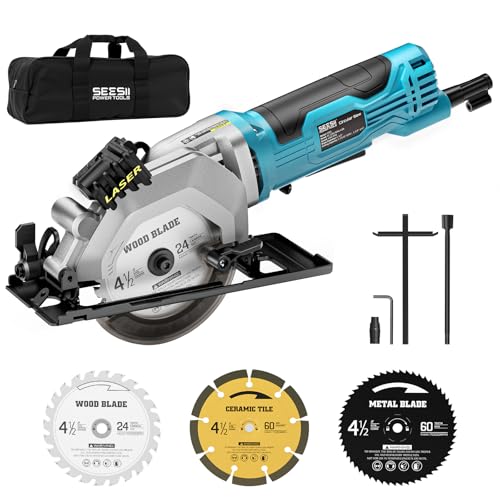
The Seesii mini circular saw includes a laser guide and multiple blades (4-1/2″ blades with TCT, HSS, and diamond options). With a 4.8-amp motor, it supports up to 4000 rpm, enabling sharper, straighter cuts for wood, soft metal, tile, and plastic. A dust hose adapter helps maintain a cleaner workspace, improving visibility during operation, and making it suitable for DIY projects in constrained spaces.
Buying Guide: Key Purchase Considerations For Lightweight Circular Saws
- Power and size balance: Look for a motor between 4.0–13 amps and blade sizes around 4–7-1/4 inches. A lighter tool reduces fatigue without sacrificing essential cutting capacity.
- Ergonomics: Check handle design, grip texture, and weight. Tools marketed as one-handed or with balanced weight distribution tend to be easier to control for extended use.
- Bevel and depth settings: A bevel range up to 45° or 51° with positive stops expands cut versatility. Ensure depth adjustment is crisp and easy to lock in place.
- Guidance systems: Laser guides, parallel guides, and rubberized grips help improve accuracy, particularly for precise cuts in furniture and cabinetry projects.
- Dust management: A built-in vacuum connection or dust port helps keep workspaces clean, which can improve visibility and safety.
- Corded vs. cordless: Cordless models offer mobility but depend on battery life; corded options provide steady power for continuous use. Consider project scope to decide which fits best.
- Blade compatibility: Ensure the saw accepts common blade sizes and types (carbide-tipped blades are standard for wood; some models offer multi-material blades or easy blade changes).
- Safety features: Look for blade guards, spindle locks for quick blade changes, and guards that retract smoothly to minimize snag hazards.
- Price-to-performance: For beginners, prioritize comfortable grip, stable baseplate, and straightforward depth control over high-end features.
- Maintenance and replacement parts: Availability of blades, guides, and service support influences long-term usability.
The picks above illustrate a range of options that emphasize manageable weight, practical cutting capacity, and user-friendly features. They are suitable for entry-level users seeking safer, more controllable tools for home projects, as well as more experienced hobbyists who need portable, lightweight options for quick tasks around the shop.