Best Circular Saw Blades for MDF: Clean Finish Every Cut
MDF presents a unique challenge for circular saw blades. Its dense, fiber-filled composition can chip easily along the edges, so choosing blades with fine teeth and precise kerf helps deliver smooth, stable cuts. The blades below are among the top options for MDF and related materials like plywood, laminates, and veneer. This guide highlights five blades that balance finish quality, heat management, and saw compatibility to help you pick with confidence.
| Product | Brand | Arbor | Teeth | Best For |
|---|---|---|---|---|
| Echo Corner 6-1/2″ 60T Fine Finish Blade | Echo Corner | 5/8″ | 60 | Fine finish on MDF and plywood |
| OA-BRES 7-1/4″ 60T Finish Blade (3-Pack) | OA-BRES | 5/8″ | 60 | All-around wood cutting with finish option |
| Echo Corner 5-1/2″ 48T + 24T Combo Pack | Echo Corner | 10 mm | 48 / 24 | Finish and rip cuts in MDF and plywood |
| Diablo Ultra Finish 7-1/4″ Blade | Diablo | 5/8″ | 60 | Ultra-finish crosscuts and rips |
| Luckyway 7-1/4″ 60T Finish Blade | Luckyway | 5/8″ | 60 | Clean edge finishes on MDF and laminates |
Echo Corner 6-1/2 Inch 60T Finish Blade
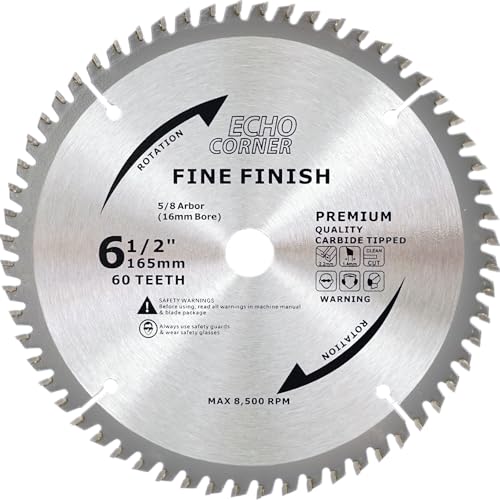
This blade features 60 teeth with ATB geometry to deliver fine crosscuts on MDF, plywood, and laminates. A 5/8″ arbor fits standard saws, and tungsten carbide tips promote durability under heavy use. The fine-cut performance minimizes edge tear-out, making it a strong choice for cabinetry or panel edging where a smooth face is essential.
Designed for precision workflows, it works well on both softwood and engineered panels. The combination of a dense tooth pattern and a clean kerf helps reduce waste while maintaining steady cutting speed. This blade is particularly well-suited for long runs where finish quality matters as much as cutting speed.
OA-BRES 7-1/4 Inch 60T Finish Blade

The OA-BRES set includes three blades: 24T for framing and ripping, 40T for cross-cutting, and 60T for finishing cuts, all in a single package with a 5/8″ arbor. The blades are built from durable alloy steel with hardened tungsten carbide teeth and a polished surface to extend life and maintain sharpness. The 60T finish blade is optimized for MDF and plywood, delivering clean edges with minimal effort.
The combination design allows you to swap blades as your cut type changes, reducing setup time on the job. The ATB tooth pattern contributes to smooth, accurate cuts with reduced tear-out on panel materials, which is particularly helpful when working with MDF that can chip at rough edges.
Echo Corner 5-1/2 Inch 48T + 24T Combo Pack

This combo pack offers two blades: a 48T finishing blade and a 24T ripping blade, both with a 10 mm arbor. The 48T blade is designed for smooth, clean cuts through MDF and veneer laminates, while the 24T blade handles faster material removal along the grain. The dual-blade setup is ideal for tradespeople who frequently switch between finish work and rapid material processing.
The 48T blade minimizes chipping on delicate surfaces and edges, while the 24T blade maintains a strong cutting rate for rough-cut operations. The different tooth counts give you flexibility across various project requirements without needing multiple separate blades on site.
Diablo Ultra Finish 7-1/4 Inch Blade

Diablo’s Ultra Finish blade uses TiCo Hi-Density carbide tailored to each application to maximize performance and durability. The Perma-SHIELD non-stick coating protects the blade from heat, gumming, and corrosion, helping it stay sharp longer on MDF, plywood, and melamine. A thin laser-cut kerf reduces resistance and heat buildup, delivering fast, clean crosscuts and rips with minimal tear-out in panel materials.
With a 60T configuration and a 7-1/4″ diameter, this blade is well-suited for fine finish work on cabinetry and sheet goods. The cutting geometry supports precise, stable cuts, particularly on hard finishes and laminates that can dull lower-tooth blades quickly.
Luckyway 7-1/4 Inch 60T Finish Blade

Luckyway’s 60T finish blade is designed for cross-cutting and finishing cuts in softwood, hardwood, plywood, and MDF. The fully hardened steel blade body resists bending and deflection, helping to maintain true cuts even during longer runs. The 5/8″ arbor aligns with most standard saws, and the 60 teeth provide a clean edge suitable for cabinetry, shelving, and face frames.
The blade balances finish quality with cutting speed, making it a versatile choice for users who frequently switch between MDF panels and other wood types. Its durable construction helps maintain edge retention across multiple projects without frequent replacements.
Buying Guide
Key purchase considerations for MDF blades
For MDF, the balance between tooth count and speed is critical. Higher tooth counts (60T) yield smoother edges and reduce tear-out but cut more slowly. If you work with heavy panel stock or require rapid cuts, a 24T or 40T blade may be better for shaping and roughing, followed by a finish blade for final passes. Coatings like Perma-Shield can help prevent heat build-up and gumming, especially on dense MDF. Look for blades with a robust body and reinforced heat-diffusion features to extend life during long runs.
Blade geometry and finish quality
ATB (Alternating Top Bevel) teeth provide cleaner crosscuts with less tear-out on MDF and plywood. A thin kerf minimizes waste and reduces resistance, allowing the saw to glide through panels with less effort. For finish work, prioritize blades with higher tooth counts and precision grinding. If your projects involve laminates or veneer, choose blades designed to minimize chipping at the cut edge.
Arbor size and saw compatibility
The most common arbor size is 5/8″, but some blades use metric or 10 mm arborings. Always confirm your saw’s arbor size before purchasing. Adapters exist, but using the correct arbor improves blade stability and reduces vibration. When working with multiple saws, selecting blades with multiple compatible arbor options or included shims can simplify tool setup.
Material, durability, and maintenance
Carbide-tipped blades offer longer life on MDF, plywood, and laminates compared with steel blades due to their hardness and wear resistance. A non-stick coating helps resist gumming from MDF resins. Regularly inspect blades for chipped teeth or warping and clean kerf debris after use to maintain performance. Store blades in a dry, organized rack to prevent rust and dulling from humidity.
When to choose which blade
Use a 60T finish blade for final MDF cuts to minimize tear-out and leave a clean edge. For rapid panel cutting or rough sizing, a 24T or 40T blade may be more efficient, followed by a dedicated finish blade. If your projects blend different materials, a 3-blade set or a combo pack can provide the broadest capability with minimal downtime between tool changes.