Best Blade for Ripping Hardwood: Top Choices for Clean, Fast Rips
Choosing the best blade for ripping hardwood can dramatically improve cutting speed, edge quality, and overall project accuracy. The right ripping blade minimizes tear-out, reduces the need for sanding, and keeps dust under control by delivering clean, straight cuts through dense woods such as oak, maple, and hickory. The blades below emphasize common hardwood ripping needs: robust carbide, stable flat-top geometry, and suitable kerf for a balanced motor load. The following selections are designed to help American woodworkers find a blade that matches their saw and workload.
Scroll the product table for quick specs and then dive into detailed sections to compare performance, compatibility, and finishing outcomes.
| Product | Brand | Teeth | Kerf | Diameter |
|---|---|---|---|---|
| Freud Heavy-Duty Rip Blade LM72M010 | Freud | 24 | .126 in | 10 in |
| FOXBC 10-Inch Thin Kerf Ripping Blade | FOXBC | 24 | .094 in | 10 in |
| Freud Thick Stock Rip Blade LM71M012 | Freud | 20 | Thick Kerf | 12 in |
| Freud Industrial Glue Line Ripping Blade LM75R010 | Freud | 30 | Thin Kerf | 10 in |
| Diablo D1024X Ripping Blade | Diablo | 24 | .098 in | 10 in |
Freud 10-Inch Heavy-Duty Ripping Blade

Freud’s LM72M010 delivers smooth, fast ripping in hardwoods and softwoods. Its rigid body and razor-sharp flat-top carbide teeth provide glue-line precision, ideal for stock 3/4″ to 2-3/4″ thick. The 10″ blade features 24 teeth, a 5/8″ arbor, and a 0.126″ kerf to balance material removal with cutting speed, making it versatile for framing, cabinetry, and finish work in home workshops.
The Premium TiCo Carbide Blend enhances edge retention and durability, enabling consistent performance through dense woods. Oversized flat teeth yield an ultra-smooth finish, often reducing sanding or jointing steps in Cabinetry and finish carpentry tasks.
FOXBC 10-Inch Thin Kerf Ripping Blade

The FOXBC 10-Inch Thin Kerf Ripping Blade is designed for fast, clean rip cuts with 24 teeth. Its kerf is 0.094″, plate thickness 0.071″, hook angle 20°, and 5/8″ arbor. The thin kerf minimizes horsepower requirements, enabling quicker starts and reduced wear on the saw while ripping hardwoods and softwoods alike.
Manufactured from high-density tungsten carbide, this blade resists wear and maintains a sharp edge through long ripping sessions. The design also reduces vibration and noise, delivering a smoother finish on various woods and a more comfortable cutting experience for hobbyists and professionals alike.
Freud 12-Inch Thick Stock Rip Blade

Freud LM71M012 is built for ripping thick stock, with a 12″ diameter and 20 teeth. Its flat grind and thick kerf design promote blade stability and extended life under demanding ripping conditions, handling stock from 1-1/2″ to 3-1/2″ thick. The larger gullets support efficient chip removal, enabling faster material cutting in hardwoods and softwoods alike.
The blade uses a premium TiCo carbide blend to maximize cutting performance, edge retention, and durability, ensuring consistent, clean results even on fast, aggressive passes through dense timber.
Freud Industrial Glue Line Ripping Blade LM75R010
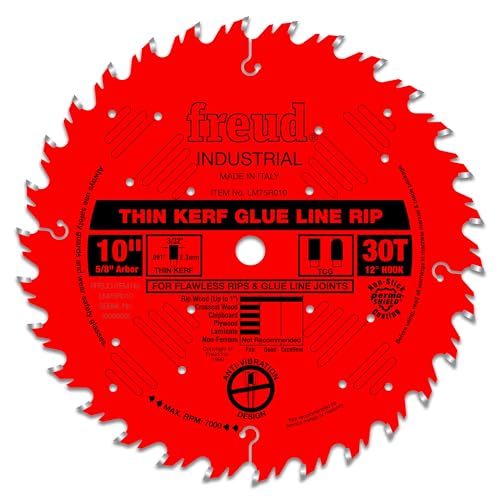
Freud LM75R010 offers a 10″ diameter with 30 teeth and a thin kerf, designed for glue-line ripping tasks. The triple-chip tooth design yields exceptionally smooth, true-cut surfaces suitable for glue-ready edges without sanding or jointing. The blade runs on the TiCo Hi-Density carbide blend to maximize cutting performance and edge retention across hardwoods and plywood.
Designed for reliable, heavy use in demanding applications, this blade provides a balance of high-speed ripping and finish-quality surfaces, making it a strong choice for cabinetry and trim work where glue lines matter most.
Diablo 10-Inch Ripping Blade D1024X

Diablo’s D1024X is a dependable 10″ ripping blade with 24 ATB teeth, a 5/8″ arbor, and a 0.098″ kerf. The 15° hook angle and Hi-Density TiCo carbide support fast, accurate ripping through hardwoods and softwoods while delivering clean, straight cuts. The Perma-SHIELD coating helps protect against heat, gum buildup, and corrosion for longer blade life in busy shops cutting plywood and OSB.
The combination of a thin kerf and a capable grind makes this blade suitable for aggressive ripping where a balance between speed and finish quality is required, particularly in cabinetry and framing projects.
Buying Guide
- Kerf and saw power: Thin-kerf blades (roughly 0.071″–0.094″) require less horsepower and reduce waste, making them ideal for underpowered saws or when cutting thin stock. Thick kerf blades remove more material quickly but demand more motor power and can strain the saw on hard, dense timbers.
- Tooth count and grind: Lower tooth counts (around 20–24) excel at ripping speed, especially in hardwoods, while higher counts (30) help produce glue-line and finish-ready surfaces. Grind types such as ATB (alternate top bevel) and triple-chip are chosen based on desired finish; triple-chip avoids chipping on delicate edges and glue lines, while ATB focuses on clean ripping in various woods.
- Carbide and coatings: TiCo or Hi-Density carbide blends offer strong edge retention and durability for dense hardwoods. Coatings like Perma-SHIELD help reduce heat buildup and gum buildup, extending blade life in busy workshops.
- Diameter, arbor, and compatibility: Match the blade diameter and arbor size (most common is 5/8″) to your table saw. Ensure the blade height and plate thickness fit your saw’s capacity and do not exceed the maximum cutting height. Be mindful of saw vibration and balance when using larger-diameter blades on lightweight or underpowered tools.
- Application fit: For thick stock ripping, consider blades with larger gullets and flat or slightly aggressive ground teeth to maximize material removal. For glue-line work, prioritize blades with a design that produces smooth, true-cut edges with minimal finishing work.
- Maintenance and longevity: Regularly clean the blade to prevent pitch build-up, check for warping or wobble, and store blades in a dry, protected place. Replacing blades at the first signs of dullness or chipping helps maintain cutting quality and safety.