Best Blades for Miter Saws for Ultra-Finish, Precise Cuts
Choosing the right miter saw blade can dramatically impact finish quality, accuracy, and cut efficiency. This guide highlights top blades across brands, focusing on fine finishes, durability, and cutting cleanly through various woods. Each option emphasizes thin kerf design, carbide durability, and compatibility with standard 10- or 12-inch saws, helping you select a blade tailored to framing, cabinetry, and finish work alike.
| Product | Brand | Diameter | Teeth | Kerf | Arbor |
|---|---|---|---|---|---|
| Freud LU91R012 | Freud | 12 inch | 72 | Thin | 1/2 inch |
| DEWALT DWA112CMB | DEWALT | 12 inch | 40/60 | Fine | 1/2 inch |
| WEN BL1080 | WEN | 10 inch | 80 | Ultra-thin | 5/8 inch |
| WEN BL1200 | WEN | 12 inch | 100 | Ultra-thin | 1 inch |
| ANGELSWORD 3-Pack | ANGELSWORD | 10 inch | 32/60/80 | Thin | 5/8 inch |
Note: The table above summarizes key specifications across five blades chosen for versatile miter saw work—from framing to fine finish. The selected items emphasize thin kerf for less horsepower, carbide durability for longer life, and compatibility with common saw arbor sizes.
Freud Thin Kerf Sliding Miter Saw Blade LU91R012

The Freud LU91R012 packs a 12-inch diameter with 72 teeth and a premium TiCo carbide crosscutting blend. Its negative hook angle (5°) reduces aggressiveness, helping to keep the blade steady against the fence while delivering clean crosscuts. The thin kerf design minimizes material removal, which translates to less horsepower demand and improved finish results in joinery, framing, and cabinetry tasks. The blend balances edge durability with speed, making this blade suitable for tough hardwoods and softwoods alike, while maintaining precise, repeatable cuts.
Key features support accuracy and longevity: negative hook angle reduces chatter, high-density TiCo carbide provides wear resistance, and a thin kerf means smoother cuts with reduced blade wander. This blade is well-suited for finish carpentry where clean edges are critical and frequent crosscuts are common. For users prioritizing finish quality on a 12-inch miter saw, the LU91R012 offers dependable performance with consistent results across varied species.
DEWALT Miter Saw Blade Combo Pack DWA112CMB

The DEWALT DWA112CMB combo pack delivers versatility with 12-inch blades featuring 40-tooth and 60-tooth configurations. Engineered for increased accuracy and longer life, these blades incorporate a patented body slot design that reduces vibration and enhances stability during cuts. The optimized tooth geometry supports clean, precise crosscuts and bevels, benefiting tasks ranging from picture frames to cabinet components. This pack is designed for woodworking environments where a reliable, finish-oriented blade pairing is valuable for a range of materials and cut types.
Highlights include enhanced blade stability, reduced vibration for smoother cuts, and carbide teeth designed to hold a sharp edge. The combination offers a practical balance of fine finishing capability and daily durability, making it a solid choice for hobbyists and professionals who run a mix of projects through their miter saws. While not the absolute finest single-tooth blade, the value and flexibility of the pack support consistent performance across a spectrum of workloads.
WEN BL1080 10-Inch 80-Tooth Ultra-Fine Finish Blade

This WEN blade is designed for ultra-fine finishes with an 80-tooth count on a 10-inch platform. The ultra-thin kerf, at about 0.10 inches, minimizes material removal and reduces resistance, helping to preserve power and deliver cleaner cuts with less deflection. The blade’s carbide tips are built to sustain sharpness through many crosscuts in softwoods and hardwoods alike. A 5/8-inch arbor matches standard miter saw configurations, making installation straightforward for most common tools.
Usage considerations include the trade-off between speed and finish quality. With more teeth, you get a finer cut and smoother edge, but feed rates may slow slightly on denser materials. For cabinetry, trim work, and finish carpentry where a flawless face cut matters, the BL1080 provides a reliable solution that pairs well with satin finishes and pre-finished materials. Routine maintenance, including burnishing and occasional blade cleaning, helps maximize its lifespan.
WEN BL1200 12-Inch 100-Tooth Ultra-Fine Finish Blade

The WEN BL1200 is a 12-inch blade featuring 100 teeth and a thin kerf for ultra-fine finish cuts. A 1-inch arbor accommodates larger saws while delivering consistent performance. The blade’s fine-tooth design is ideal for fine finish work, including cabinet doors, trim, and moldings, where precision edge quality is essential. The 6,000 RPM rating ensures compatibility with most standard miter saws while maintaining cutting efficiency across a range of hardwoods and softwoods.
Edge durability and heat resistance are supported by carbide teeth designed to retain sharpness under repeated use. For users who prioritize ultra-smooth edges and minimal tear-out, especially on veneered panels or prefinished stock, the BL1200 offers a dependable option with broad material compatibility and a relatively light kerf that reduces resistance during cutting.
ANGELSWORD 3-Pack: 32T/60T/80T 10-Inch Blades
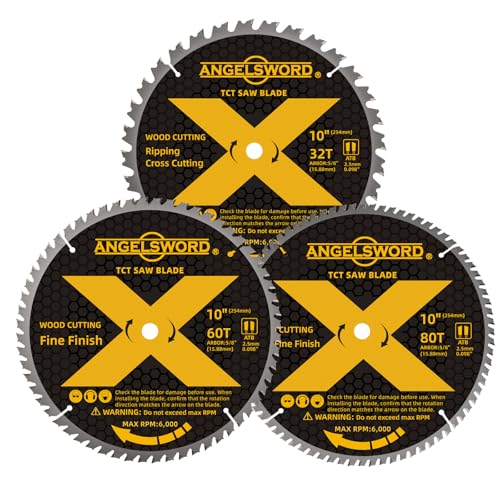
The ANGELSWORD 3-pack offers 32T, 60T, and 80T blades for 10-inch miter saws with a common 5/8-inch arbor. This set enables a quick switch between coarse, fine, and ultra-fine finishes without changing blades. The 0.098-inch kerf (2.5 mm) provides a balanced cut, suitable for framing, bevels, and precise crosscuts. Tungsten carbide teeth deliver wear resistance and longevity, accommodating varied wood species and project types.
Use cases include heavy framing (32T), general crosscuts (60T), and fine finish work (80T). The broad tooth range supports a flexible workflow, allowing users to optimize for speed or finish depending on the task. For shops or job sites needing quick blade swaps for different stages of a project, this pack offers convenience and consistent performance across a range of wood types.
Buying Guide: Key Purchase Considerations
- Material and finish goals: Choose blades with higher tooth counts (like 72–100) for finer finishes, and lower counts (32–60) for faster framing cuts. Thin kerf reduces horsepower demand and improves finish quality.
- Blade geometry: Positive vs negative hook angle affects aggressiveness and control. Negative hook angles tend to reduce kickback and help maintain fence alignment on heavy cuts.
- Carbide quality: TiCo and premium carbide blends offer better edge retention and longer life under repeated cuts in hardwoods and softwoods alike.
- Arbor compatibility: Most 10-inch blades use a 5/8-inch arbor; 12-inch blades often use 1/2-inch to 1-inch. Confirm your saw’s arbor size before purchasing.
- Finish requirements: For cabinet doors, moldings, and trims, prioritize blades marketed for ultra-fine or finish cuts with a thin kerf to minimize tear-out.
- Vibration and stability: Blades with optimized body slots and balanced construction contribute to smoother cuts and reduced vibration, benefiting accuracy on long runs.
- Budget and versatility: A multi-pack can offer value and flexibility for varied tasks, while single-purpose high-finish blades deliver maximum edge quality for specific jobs.
- Maintenance: Regular cleaning and occasional sharpening extend blade life. Store blades dry to prevent rust and corrosion on carbide teeth.