Best Blades for Miter Saw: Clean, Precise Finishes for Any Woodworking Project
Choosing the right miter saw blade turns rough-cut lumber into smooth, accurate edges. This guide reviews top-performing 10 and 12-inch blades designed for softwoods, hardwoods, and plywood, highlighting kerf, tooth design, and durability. Whether you’re trimming trim, making picture frames, or cutting panels for cabinets, a sharp, well-suited blade is essential for consistent results and reduced post-cut sanding.
| Product | Brand | Best For | Tooth Count / Kerf |
|---|---|---|---|
| WEN BL1080 | WEN | Ultra-fine finish, hardwood and softwood | 80T, 0.098″ kerf |
| WEN BL1040 | WEN | Fast, clean cross-cuts | 40T, 0.098″ kerf |
| DEWALT DWA112CMB | DEWALT | Fine finish, dual-pack versatility | 40T & 60T, approx 0.098″ kerf |
| WEN BL1280 | WEN | Fine finish on larger stock | 80T, 0.098″ kerf |
| Diablo D1060X | Diablo | Ultra-smooth finish, high durability | 60T, 0.098″ kerf |
WEN BL1080: Ultra-Fine Finish Blade

The WEN BL1080 is a high-tooth-count blade designed for precise, smooth cuts on both hard and softwoods. Its 10-inch diameter and 5/8-inch arbor match most standard miter saws, with an ultra-thin kerf of 0.10 inches (2.4 mm) that reduces waste and minimizes chatter. Rated up to 6000 RPM, this blade is ideal for fine finish work, such as door casings, moulding, and other trim where clean edges matter.
WEN BL1040: 40-Tooth Finish Blade
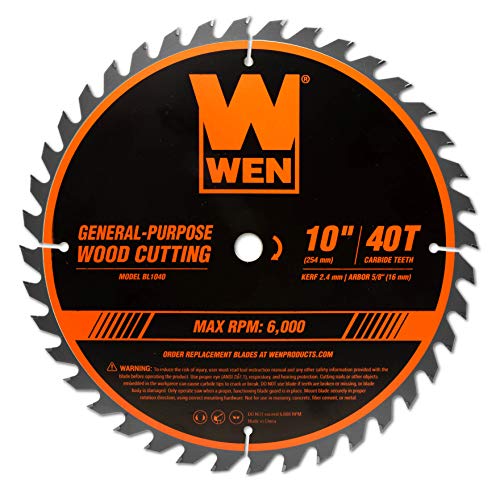
The WEN BL1040 focuses on faster, more aggressive cross-cuts while delivering a clean finish. With the same 10-inch diameter and 5/8-inch arbor, this blade’s 40 teeth strike a balance between speed and refinement. It’s well-suited for projects where a quicker cut is prioritized and a light finish is acceptable, such as rough carpentry or framing where subsequent planing is planned.
DEWALT Combo Pack: 40T & 60T

The DEWALT combo pack provides versatility for different tasks. The 40-tooth blade excels in fast, clean cross-cuts, while the 60-tooth blade is designed for finer finishes. Featuring a patented body slot design to reduce vibration and maximize accuracy, these blades are optimized for precise cutting with minimal chatter, making them a reliable choice for cabinetry and trim work where repeatable results are essential.
WEN BL1280: Fine-Finish, 80-Tooth
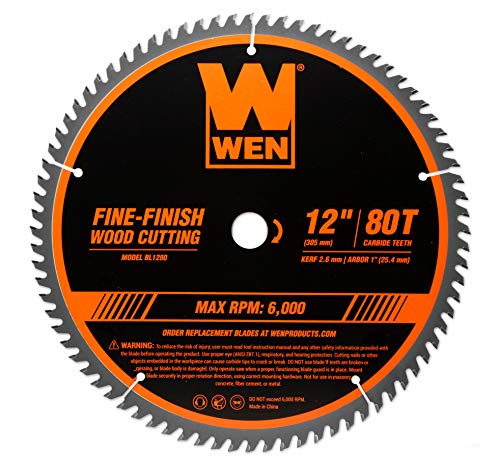
With a larger 12-inch diameter, the WEN BL1280 targets fine woodworking tasks that require longer reach and deeper cuts. Its 1-inch arbor supports robust mounting, and the blade runs up to 6000 RPM. The 80-teeth, combined with a narrow kerf of about 0.102 inches (2.6 mm), yields exceptionally smooth surfaces and minimal burning on hardwoods, making it suitable for door components, window casings, and high-precision panel work.
ANGELSWORD 2-Pack: 40T & 60T

This Angelsword two-pack includes a 40-tooth blade for fast cutting and a 60-tooth blade for finer finishes. The blades use a 5/8-inch arbor and a 0.098-inch kerf, designed for quick work on softwood, hardwood, and plywood. The set provides flexibility for mixed-material projects, allowing users to switch between speed and precision without changing tools.
Buying Guide
Key considerations when choosing a miter saw blade include blade diameter, tooth count, kerf width, arbor size, and material compatibility. Higher tooth counts (like 60–80T) yield smoother finishes but cut more slowly, making them ideal for trim, cabinetry, and veneers. Lower tooth counts (40T) cut quickly and are better for framing or rough cuts where a subsequent finish is planned.
Kerf width affects waste and heat: thinner kerf blades (around 0.098–0.102 inches) reduce material loss and require less power, while thicker kerfs can add stability on large cuts. Arbor compatibility (5/8 inch is common) ensures secure mounting on most consumer miter saws. For finished carpentry, consider Hi-ATB or carbide teeth engineered for heat resistance and longer blade life, as these features help maintain sharpness during repeated cuts.
Material considerations are critical. For softwoods like pine, most standard 40–60T blades perform well. For hardwoods (oak, maple), finer blades with 60–80T are preferred to minimize tear-out. Plywood and laminates benefit from blades with precise tooth geometry to prevent chipping along edges. If you frequently switch between materials, a combo pack with two or more blades can simplify tool setup and optimize results across tasks.
Durability features such as coating (e.g., TiCo or Perma-Shield) help resist heat buildup, corrosion, and gumming in challenging jobs. Look for low-vibration designs and body-slot technology to reduce wandering and ensure accurate cross-cuts, especially during long sessions. Finally, verify that the blade is designed for miter saws and table saws with compatible RPM ratings to prevent premature wear.
In summary, select blades based on a balance between cut quality and speed, aligned with typical project needs. For finish work, prefer higher tooth counts and fine kerf designs. For rough framing, lower tooth counts with robust construction provide speed and durability. A mixed blade set can cover most common tasks without constantly swapping tools.