Best Blades for Cutting Cement Board: Durable PCD Saw Blades Guide
Choosing the right blade is essential for clean, efficient cuts in cement board. This guide highlights top-rated PCD-tipped and carbide blades designed to slice fiber cement and other hard materials with less dust, longer life, and reliable performance. Each product below is evaluated for cutting life, dust reduction, and compatibility with common saws. Use the buying guide at the end to compare options and pick the best blade for your project.
| Product | Brand | Type | Arbor |
|---|---|---|---|
| Diablo HardieBlade Fiber Cement Saw Blade – 7-1/4″ | Diablo | PCD Tipped | 5/8″ |
| Diablo HardieBlade Fiber Cement Saw Blade – 10″ | Diablo | PCD Tipped | 5/8″ |
| TWIN-TOWN 7-1/4″ PCD Hardie Blade | TWIN-TOWN | PCD Tipped | 5/8″ |
| Janchi 7-1/4″ PCD Tip Hardie Blade | Janchi | PCD Tipped | 5/8″ |
| Janchi 6-1/2″ PCD Tip Hardie Blade | Janchi | PCD Tipped | 5/8″ |
The blades listed here are selected for fiber cement and similar hard materials. They emphasize long life, reduced dust, and compatibility with common power tools. Each section below provides a concise overview, key features, and practical considerations to help you compare options quickly.
Diablo HardieBlade Fiber Cement Saw Blade – 7-1/4″ D0704DH
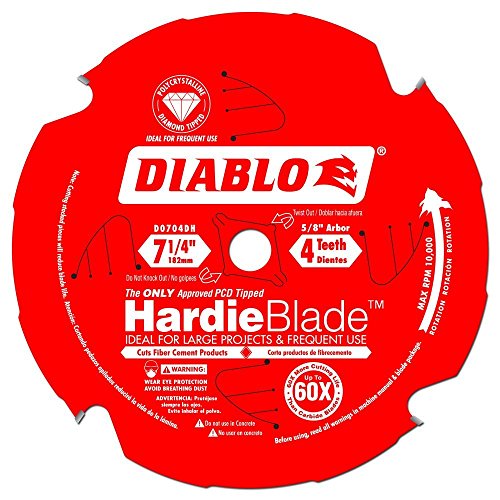
Designed for fiber cement cutting, this Diablo blade features a PCD triple chip design that can dramatically extend cutting life, with claims of up to 75X longer life than standard carbide blades. It also aims to generate up to 50% less respirable dust, contributing to a safer, cleaner work environment. James Hardie approves this blade, signaling reliable performance for cement board projects. For 7-1/4″ saws, it provides fast, long-lasting cuts with reduced maintenance between uses. Consider this blade when durability and dust control are priorities.
Diablo HardieBlade Fiber Cement Saw Blade – 10″ D1006DH

This 10″ Diablo blade uses PCD teeth to tackle fiber cement with enhanced life and cutting performance. It features a 5/8″ arbor and a relatively thin kerf to balance speed and debris management for larger board cuts. With PCD teeth, it’s suited for repeated, heavy-duty cuts where blade longevity is critical. The blade is positioned for professional use on fiber cement installations and similar hard composites.
TWIN-TOWN 7-1/4″ 6-Tooth PCD Hardie Blade

Featuring a 1.8 mm kerf and a 7-1/4″ diameter, this blade emphasizes a fast, smooth cut with minimal waste. The six-tooth PCD design targets hard fiber cement materials like HardiePlank and Eternit, with an anti-stick coating to reduce heat buildup. It’s designed to deliver reliable life and consistent cuts across composite cement boards and similar substrates, making it a strong option for residential fiber cement installations.
Janchi 7-1/4″ 4T PCD Tip Hardie Blade

Janchi’s 7-1/4″ blade combines four PCD-tipped teeth with a 5/8″ DMK arbor. It promises up to 60x longer cutting life than standard carbide blades, along with an ultra-thin kerf (1.8 mm). The laser-cut body, anti-vibration features, and expansion slots support fast, precise cuts with reduced dust and waste. This blade is well-suited for fiber cement boards and other ultra-hard materials used in flooring and siding projects.
Janchi 6-1/2″ 4T PCD Tip Hardie Fiber Cement Blade

This smaller, 6-1/2″ blade by Janchi offers a four-tooth PCD configuration designed for fast, clean cuts in fiber cement boards and similar hard materials. The blade emphasizes long life, a thin kerf for efficiency, and a focus on reduced dust. The DMK arbor compatibility ensures broad tool compatibility for various compact saws used in remodeling and installation projects.
Buying Guide: Key Considerations For Cement Board Blades
- Material compatibility: PCD-tipped blades excel on cement-based composites like Hardie boards. Carbide edges can wear quicker when cutting very hard fiber cement, so PCD is often preferred for longevity.
- Kerf and cut speed: A thinner kerf (0.071″ to 0.079″) reduces material removal and can improve speed, but it may require more precise handling to avoid deflection.
- Arbor size: Most listed blades use a 5/8″ arbor, which fits many standard circular saws. Verify your tool’s arbor before purchasing.
- Dust reduction: Some PCD blades claim reduced respirable dust generation, which is beneficial for indoor work and health compliance.
- Life expectancy vs cost: PCD blades typically offer longer life in hard materials, potentially reducing frequent blade changes on large projects. Consider total cost of ownership rather than upfront price.
- Tool compatibility: For larger blades (like 10″), ensure your saw can safely accommodate the diameter and that the motor provides adequate RPM for optimal performance.
- Brand approvals: James Hardie and other industry endorsements can indicate reliable performance for cement board work. Check for product approvals and service life claims.
- Application scope: Some blades are optimized for dry cutting, while others tolerate wet cutting or mixed media. Align blade choice with your site conditions and ventilation requirements.
When planning cutting tasks for cement board, consider a blade that balances life, dust control, and cutting precision. For repetitive, long cuts along walls or siding, a PCD-tipped blade is often the most economical choice. For intricate cuts or thinner boards, a blade with a smaller kerf and robust anti-vibration features can help maintain accuracy and reduce fatigue.