Best Basement Wall Sealers for Waterproofing and Crack Repair
Protecting basement walls from moisture and radon intrusion requires choosing the right sealer or crack-repair system. The following five products offer a range of approaches—from penetrating sealers that block moisture at the source to flexible surface coatings and drill-free crack-injection kits. This guide focuses on proven options for concrete basement walls and foundations, emphasizing durability, ease of use, and indoor suitability. Use this selection to determine whether you need deep protection, crack-specific repair, or a reliable surface seal for ongoing basement maintenance.
| Product | Brand | Core Benefit | Volume / Kit |
|---|---|---|---|
| RadonSeal Plus Deep Penetrating Concrete Sealer for Basement Walls and Floors | RadonSeal | Deep penetration; blocks water, vapor, efflorescence, and radon | 2.5 Gallons |
| RadonSeal Complete DIY Foundation Crack Repair Kit | RadonSeal | Drill-free crack injection; interior wall sealing | 10 Ft Kit |
| RadonSeal DIY Concrete Foundation Crack Repair Kit (20-ft) | RadonSeal | No drilling; hairline crack repair across longer runs | 20 Ft Kit |
| Liquid Rubber Basement and Foundation Repair Sealant | Liquid Rubber | Flexible membrane; waterproofing and crack bridging | 1 Gallon |
| Ames Block & Wall Liquid Rubber Waterproofer | AMES | Rubberized coating for waterproofing walls | 1 Gallon |
RadonSeal Plus Deep Penetrating Sealer

RadonSeal Plus Deep Penetrating Concrete Sealer is engineered to protect basement walls and floors by delivering deep penetration into concrete pores. This approach creates a protective barrier inside the capillaries, reducing moisture migration, dampness, and efflorescence while addressing radon concerns in enclosed spaces. The product is designed for poured concrete and masonry surfaces common in basements, offering long-lasting performance beyond a surface coating. It is compatible with interior use and emphasizes a low-odor, low-VOC profile once cured.
The formulation emphasizes durability through deep penetration rather than a mere surface seal. By occupying internal pores, it helps stabilize the substrate against seasonal moisture changes and minor structural movement. While it provides substantial protection on its own, it can be part of a comprehensive basement waterproofing plan that includes surface coatings or crack-repair methods for additional peace of mind.
RadonSeal Complete DIY Foundation Crack Repair Kit

This kit provides a drill-free solution for sealing basement wall cracks with Hydra Stop 300 polyurethane foam. The system expands to fill cracks from the inside, creating a durable, waterproof barrier that helps prevent water intrusion and radon gas entry. It is designed for interior applications and is accessible to homeowners using a standard caulking gun for injection. The kit targets a range of crack sizes—from hairline to wider gaps—delivering a robust, long-term seal once cured.
Designed for straightforward DIY use, the RadonSeal Complete kit emphasizes simplicity and effectiveness. The polyurethane foam forms a lasting seal that resists future cracking and movement, making it a practical option for common basement crack repair scenarios. This approach is particularly suitable when exterior access is limited or when indoor sealing is preferred to minimize disruption during installation.
RadonSeal DIY Concrete Foundation Crack Repair Kit (20-ft)

The 20-foot RadonSeal kit extends drill-free polyurethane injection to longer crack runs in basement walls and crawl spaces. It uses low-viscosity urethane designed for interior crack repair, enabling homeowners to seal longer crack networks without excavation. The system is suitable for hairline cracks as well as moderate-width gaps, helping to reduce water seepage and radon migration from within the wall structure. This kit is particularly useful for basements with multiple cracks aligned along a wall or foundation seam.
As with other RadonSeal products, this kit emphasizes a simple application using a standard caulking gun. The injected urethane cures to form a permanent, flexible seal that withstands temperature changes and structural movement. For basements with extensive crack patterns, this 20-foot option offers expanded coverage while maintaining a homeowner-friendly install process.
Liquid Rubber Basement and Foundation Repair Sealant

Liquid Rubber Basement and Foundation Repair Sealant provides a flexible membrane designed to seal concrete, masonry, and similar substrates. The coating bridges hairline and small cracks, offering a waterproof barrier that remains elastic under temperature shifts. The product’s 1-gallon size fits typical basement projects and supports self-leveling or irregular surfaces. Its compatibility with indoor and outdoor applications makes it a versatile option for sealing basement walls and foundation perimeters where movement and moisture are ongoing concerns.
Key advantages include high elongation and durable adhesion to multiple substrates, which helps maintain a continuous waterproof layer even as foundations experience slight shifting. This makes it suitable for DIY waterproofing efforts, particularly when combined with other measures such as surface coatings or injected crack repair where needed. For basements with consistent dampness, it provides an effective, flexible added layer on top of penetrating sealers or injected repairs.
Ames Block & Wall Liquid Rubber Waterproofer
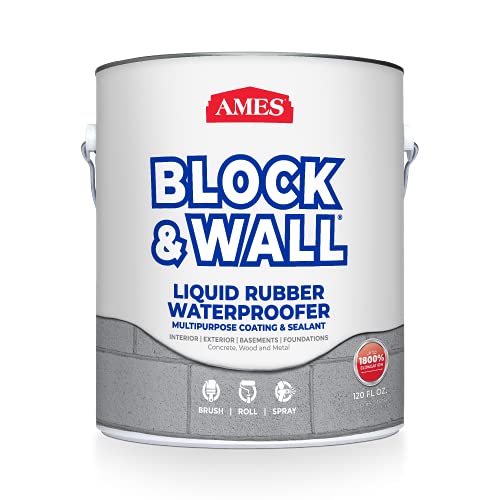
Ames Block & Wall Liquid Rubber Waterproofer offers a multipurpose, rubberized coating intended to stop water intrusion on basement walls and foundations. The white finish forms a flexible film that adheres well to concrete and masonry, creating a protective barrier against moisture movement. This product is well-suited for small to mid-sized basement areas and can serve as a supplementary layer after penetrating sealers or crack-repair systems. It is a practical option for homeowners seeking a simple surface seal with reliable elasticity to accommodate wall movement.
While surface coatings like this provide a robust barrier against ongoing dampness, they are most effective when paired with deeper protection for primary moisture sources. The coating can be applied over other sealants to enhance a basement’s moisture resistance, or used as a final protective layer in areas where high humidity is expected. The 1-gallon size makes it a convenient choice for localized sealing projects or smaller basements.
Buying Guide
When selecting a basement wall sealer, homeowners should balance depth of protection with ease of use. Start by diagnosing the problem: is it active water intrusion, persistent dampness, or radon-related concerns? Penetrating sealers target moisture at the source by reducing pore openings, while surface sealants create a moisture barrier on the wall’s surface. For cracks, dedicated injection kits offer a reliable repair path that prevents further leaks and gas ingress. For movement-prone basements, a flexible membrane is essential to maintain long-term sealing without cracking.
- Problem scope: Use penetrating sealers for moisture control within concrete pores; use surface sealants for visible dampness or as a top-layer barrier; use crack-repair kits for actual cracks in walls and foundations.
- Substrate and environment: Concrete and masonry basement walls respond best to products designed for interior concrete use. If radon is a concern, choose products proven to block radon gas ingress in basements.
- Application approach: Drill-free injection kits are ideal for interior repairs without exterior access. Surface sealants are straightforward DIY options, while penetrating sealers require proper surface preparation for best absorption.
- VOC and safety: Indoor use requires low-odor, low-VOC formulations. Always follow manufacturer safety data and cure times before reoccupying the space.
- Volume and coverage: Match product volume to wall area. For large basements, kits with longer crack-coverage or higher-volume sealers reduce the number of purchases and applications.
- Temperature and cure: Check recommended application temperature ranges and cure times. Cold or humid conditions can slow curing and affect adhesion.
- Maintenance and reapplication: Penetrating sealers may require reapplication over years, while coatings and crack repairs should be inspected periodically for signs of wear, cracking, or moisture breakthrough.
In practice, an effective basement waterproofing plan often combines several approaches. A penetrating sealer can reduce baseline moisture and radon ingress, followed by a flexible surface sealer to seal the wall face, and crack-injection kits to address visible cracks. Always consider the specific climate, wall construction, and moisture history of your basement when selecting products. For projects with extensive crack networks or high moisture loads, consulting a professional may help ensure comprehensive and durable results.