Best Adhesive for Foam Board to Concrete: Durable, Quick-Bond Solutions
Bonding foam board to concrete is a common requirement in basement finishes, insulated wall assemblies, and display structures. The ideal adhesive must resist moisture, temperature changes, and the weight of the foam while avoiding damage to the foam itself. It should offer a practical open time, strong long-term bonding, and compatibility with both foamboard and cementitious substrates. The following five products represent a blend of foamboard-specific formulas and versatile construction adhesives that perform well on foam and concrete surfaces. The table below provides a quick comparison to help you choose the right option for your project.
| Product | Brand | Type | Best For |
|---|---|---|---|
| Loctite PL300 Foamboard Adhesive (10 oz, 12 pack) | Loctite | Foamboard Adhesive | Foamboard to concrete and other surfaces |
| Loctite PL Premium Construction Adhesive (10 oz) | Loctite | Polyurethane Construction Adhesive | Foamboard to concrete, wood, masonry, metals |
| Bellisinno Construction Adhesive Heavy Duty (7.4 oz) | Bellisinno | Construction Adhesive | Concrete, tile, drywall, masonry |
| 3M 78 Polystyrene Foam Insulation Adhesive | 3M | Spray Adhesive | EPS foam to substrates (foamboard-friendly) |
| Beacon Foam Tac Adhesive Foam Glue (2 oz) | Beacon | Foam Glue | Foam materials (EPS, EPO, Depron, etc.) |
Loctite PL300 Foamboard Adhesive (10 oz)
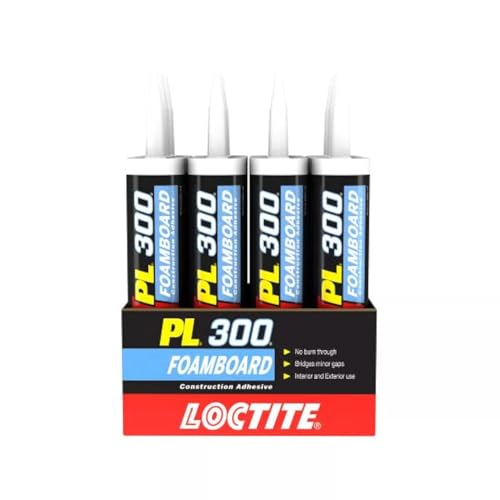
Loctite PL300 Foamboard Adhesive is engineered specifically for permanently bonding foamboard insulation to interior or exterior substrates. It delivers a strong, durable bond to foamboard as well as common materials such as wood, gypsum board, concrete, and brick, without damaging or melting the foam. The adhesive provides high grab, reducing the need for additional fasteners and support. It sets in approximately 20 minutes and cures fully in about seven days, allowing for quick handling of projects while ensuring long-term stability. The product is available as a 12-pack of 10-ounce cartridges, which suits larger applications like basement insulation or exterior foamboard assemblies. For best results, apply to clean, dry surfaces and press panels firmly into place.
Loctite PL Premium Construction Adhesive (10 oz)

Loctite PL Premium is a versatile polyurethane construction adhesive designed to bond a wide range of materials, including wood, concrete, stone, brick, masonry, foam insulation, metal, ceramic, PVC, and more. The one-component polyurethane formula delivers robust, durable bonds suitable for interior and exterior applications. It is marketed as three times stronger than ordinary construction adhesives, making it a reliable choice for subfloor installations, framing, and other high-stress connections. For foamboard projects with concrete, PL Premium offers a strong bond to the concrete substrate while remaining compatible with foamboard assemblies when used appropriately alongside surface preparation and proper clamping or fastening as needed.
Bellisinno Construction Adhesive Heavy Duty (7.4 oz)

Bellisinno’s Heavy Duty Construction Adhesive is a multipurpose cement glue designed for interior and exterior bonding on rough surfaces. The product emphasizes powerful adhesion and long-lasting performance, suitable for repairing peeling tiles, concrete, drywall, masonry, granite, and related substrates. While it is not foamboard-specific, it provides a strong, versatile option for bonding to concrete and masonry when combined with appropriate surface preparation. For foamboard-to-concrete assemblies, site-specific testing and a complementary approach (such as mechanical fastening) can help ensure structural reliability in moisture-prone environments.
3M 78 Polystyrene Foam Insulation Adhesive

3M 78 is an industrial spray adhesive designed for bonding expanding polystyrene foam (EPS). It provides an even, lace-like spray pattern that yields good coverage for foamboard applications. As a spray-on adhesive, it offers convenience for large foamboard surfaces and can facilitate bonding to certain substrates, including some concrete-adjacent surfaces, when properly prepared and allowed to cure. However, spray adhesives typically do not provide the same long-term structural strength as polyurethane construction adhesives, so this option is best suited for lightweight or non-structural foamboard assemblies or as a complementary bonding method in combination with mechanical fasteners.
Beacon Foam Tac Adhesive Foam Glue (2 oz)

Beacon Foam Tac is a fast-drying, flexible foam adhesive designed for bonding foam materials. It dries to a fully flexible bond, which helps accommodate movement and thermal expansion in foamboard assemblies. The product is compatible with common foam substrates such as EPS, EPO, and Depron, making it a good option for projects requiring temporary or lightweight foam-to-foam or foam-to-some-firm-substrates connections. While it excels in foam bonding, it is not typically used as a primary adhesive for structural concrete applications. When bonding foamboard to concrete, consider foamboard-specific adhesives or polyurethane options for higher strength and durability.
Buying Guide
Key Factors to Consider
- Substrate compatibility: Ensure the adhesive adheres well to foamboard (EPS/Polystyrene) and concrete or masonry. Some options are foamboard-specific, while others are general-purpose construction adhesives with broad compatibility.
- Bonding strength: For structural or load-bearing applications, choose products labeled as high-strength or three-times stronger than standard adhesives. Foamboard-to-concrete assemblies benefit from a strong bond plus proper surface prep.
- Open time and cure: Open (working) time indicates how long you have to position foam panels before the adhesive begins to set. Cure time indicates when the bond reaches its full strength. Shorter open times demand swift placement; longer times may help with large projects.
- Application method: Cartridge caulk guns, squeeze tubes, or spray can formats determine how you apply adhesive. For large foamboard areas, spray or cartridge formats can speed up installation; for precision joints, squeeze tubes may offer better control.
- Foam safety: Some solvents can soften or melt foamboard. Look for foam-friendly formulations when bonding EPS or similar materials to avoid damage.
- Environment and moisture: Exterior or damp environments require moisture-resistant or water-resistant adhesives. Consider curing behavior in humidity and temperature swings common to the project site.
- Durability and long-term performance: If the installation must resist movement, vibration, or weathering, prioritize adhesives with proven durability on concrete and masonry.
- Packaging and cost: Larger pack sizes (e.g., 12-pack cartridges) reduce per-unit cost for bigger projects, but consider storage and shelf life for smaller jobs.
Foamboard vs. Construction Adhesives
Foamboard-specific adhesives are formulated to bond EPS or polystyrene without dissolving the foam and typically offer good initial grab. Construction adhesives are more versatile, bonding a wider range of substrates including concrete and masonry but may require additional support or surface preparation when used with foamboard. In some projects, a hybrid approach—using a foamboard adhesive for initial bonding and a polyurethane construction adhesive for extra strength or fastening—can provide the best balance of ease of use and durability.
Surface Preparation and Application Tips
- Clean the surfaces of dust, oil, and debris. Dry substrates improve adhesion.
- For concrete, ensure the surface is sound and roughened if needed to improve bonding. Fix irregularities that could prevent full panel contact.
- Apply adhesive evenly in a continuous bead or as directed by the manufacturer. Avoid excessive squeeze-out that can be messy or wasteful.
- Position foam panels carefully within open time. Use clamps or lightweight bracing to hold panels in place until the adhesive cures.
- Follow cure times strictly; some bonds gain strength gradually, and exposure to moisture can influence long-term performance.
Storage, Safety, and Handling
Store adhesives in a cool, dry place away from direct heat or open flames. Use personal protective equipment as recommended, including gloves and eye protection when recommended by the product label. Proper ventilation is advised for solvent-containing products. Review the Safety Data Sheet (SDS) for each adhesive to understand any hazards and first-aid measures.