Best 240-Volt Portable Generator for Reliable Home Backup Power
During outages or off-grid work, a 240-volt portable generator can power essential appliances and keep important systems running. This guide highlights five top options that deliver 240V output, with features like dual-fuel capability, electric start, and transfer-switch readiness. From compact dual-fuel performers to robust tri-fuel inverter models, these units cover home backup, RV use, and job-site needs. Use the comparisons below to identify which generator best matches your power profile and fuel preferences, while prioritizing safety and ease of use.
Summary at a glance: the following table showcases five 240V-capable options, spanning traditional open-frame models and inverter-style units. Each selection offers 120/240V output, dual-fuel flexibility (where applicable), and convenient starting or remote features to simplify emergency power management.
| Product | Voltage Capability | Fuel Type | Notable Feature |
|---|---|---|---|
| WEN DF475T Dual Fuel Portable Generator | 120V/240V | Gasoline / Propane | Electric start; 224cc engine; dual-fuel flexibility |
| WEN DF680iX Dual Fuel RV-Ready Generator | 120V/240V | Gasoline / Propane | CO Shutdown Sensor; 6800W surge; 240V charging support |
| WEN DF1100T Dual Fuel Portable Generator | 120V/240V | Gasoline / Propane | Electric start; 11000W surge; 457cc engine |
| Westinghouse 12500W Dual Fuel Generator | 120V/240V | Gasoline / Propane | Remote start; transfer-switch-ready; large fuel capacity |
| Westinghouse iGen11000TFc Tri-Fuel Inverter Generator | 120V/240V | Gasoline / Propane / Natural Gas | Inverter efficiency; remote start; clean power |
WEN DF475T Dual Fuel Portable Generator

The DF475T offers a simple path to 240V backup with gasoline or propane. On gasoline, it delivers 4750 surge watts and 3800 running watts; on propane, 4350 surge and 3500 running watts. A straightforward voltage selector switches between 120V and 240V, making it suitable for transfer switches and critical loads during outages. An electric start powers a 224cc four-stroke OHV engine, allowing key-start operation for quick readiness. Dual-fuel flexibility helps when fuel availability is uncertain, while the compact frame and mobility kit ease relocation around a property or campsite. This model is well-suited for essential circuits, lighting, and sump pumps that require reliable 240V power when needed.
Best uses include home backup for essential circuits, small workshops, and RV setups with standard 120V/240V loads. Its wheel kit enhances portability, and the combination of dual fuel and 240V capability makes it a flexible choice for users who prioritize readiness and control over fuel choice. The unit’s design emphasizes straightforward operation, making it accessible for both new and experienced generators owners.
WEN DF680iX Dual Fuel RV-Ready Generator

The DF680iX provides robust dual-fuel performance with gasoline delivering 6800 surge watts and 5100 running watts, while propane delivers 6000 surge and 4500 running watts. Its 240V configuration is designed with the potential for Level 2 charging in mind, making it suitable for charging certain EVs or battery systems when connected to a transfer setup. A key safety feature is the WEN Watchdog CO Shutdown Sensor, which automatically shuts the unit down if dangerous carbon monoxide levels are detected. This model balances high power with essential safety features for family use or work sites.
Ideal applications include medium-load home backup, RV trips with 240V needs, and job sites requiring steady dual-fuel performance. The included CO shutdown sensor adds a critical layer of protection in enclosed spaces or garages. Its dual-fuel design supports flexible fuel planning, minimizing downtime caused by fuel shortages or storage constraints. A bonded-neutral 240V configuration further supports safe charging scenarios for electronics and battery systems.
WEN DF1100T Dual Fuel Portable Generator
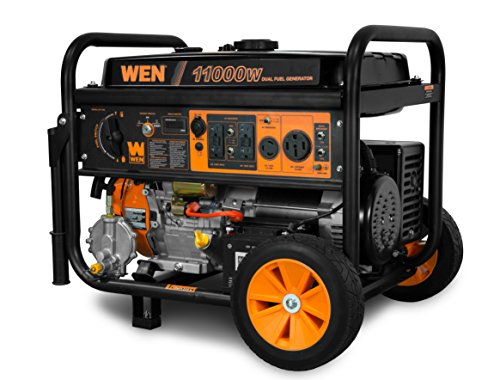
The DF1100T expands 240V capability with a substantial engine and dual-fuel versatility. Gasoline operation provides 11,000 surge watts and 8,300 running watts, while propane offers 9,500 surge and 7,500 running watts. The 120V/240V output is easily accessible via the selector switch, making it suitable for transfer switches and emergency power on a larger scale. An electric start simplifies startup, while the 457cc four-stroke OHV engine provides durable performance for extended runtimes. This generator suits homes with higher essential-load demands or contractors needing portable 240V power on the job site.
Users should consider this model for larger households, larger sump pumps, and high-demand appliances during outages. Its size and power output are well-matched to more demanding backup scenarios, and the dual-fuel capability helps ensure you’re not stranded during fuel shortages. The inclusion of wheels and a sturdy frame enhances transportability for frequent relocation between sites or garages and exterior spaces.
Westinghouse 12500W Dual Fuel Generator

The Westinghouse 12500W dual-fuel unit is designed for substantial backup power with a 6.6-gallon fuel tank and long runtimes. Gasoline operation yields 9500 running watts and 12,500 peak watts, while propane delivers 8500 running watts and 11,200 peak watts. The generator includes remote start and transfer-switch-ready capability, facilitating smooth integration with home electrical systems for whole-house backup. Durable construction and multiple outlets provide flexible connections for household circuits, RVs, or job sites that require reliable 240V power.
Use cases include larger homes needing whole-house capability, remote cabins, or commercial spaces where sustained 240V power is essential. The unit’s safety features, rubber-covered outlets, and robust engine design contribute to dependable operation during extended outages. Its dual-fuel flexibility helps ensure power availability across fuel sources while maintaining straightforward operation for homeowners and professionals alike.
Westinghouse iGen11000TFc Tri-Fuel Inverter Generator

The iGen11000TFc is a tri-fuel inverter generator offering whole-home backup capability with the benefits of inverter power. Its gas mode provides about 9000 running and 11,000 peak watts, propane mode offers 8100 running and 10,000 peak, and natural gas mode delivers 7200 running and 8,800 peak watts. Inverter technology optimizes fuel use and reduces noise while maintaining clean, stable power suitable for electronics and sensitive appliances. A 50A outlet and remote electric start support convenient integration into home or RV setups, and transfer-switch readiness makes it a strong contender for centralized backup plans.
Ideal for electronics-heavy operations, small-to-moderate home backups, and situations where quiet operation matters. Its multi-fuel capability adds resilience in varied fuel environments, while the inverter design helps protect sensitive devices from power surges. For buyers prioritizing clean power, ease of startup, and flexibility in fueling options, this model stands out for balanced performance and portability.
Buying Guide
Power needs and sizing
Accurately matching wattage with your loads prevents insufficient power or wasted fuel. Start by listing critical loads (refrigerator, well pump, furnace blower, lights) and sum their starting surge on circuits that may demand more than running watts. For 240V capability, consider whether you need a full-house transfer switch or just a few essential circuits. Inverter models excel with electronics, while open-frame dual-fuel generators typically deliver higher peak watts for short surges. A clear load assessment guides you to a unit with adequate 240V capacity without overpaying for unused reserve.
Fuel options and runtimes
Dual-fuel designs offer flexibility between gasoline and propane, which can be advantageous during outages or fuel supply gaps. Look at running watts and surge watts in both fuels to ensure your critical appliances stay powered. For larger households or continuous loads, inspect fuel tank capacity and expected runtimes at 25–50% load. Inverter models using natural gas or propane can provide steadier power with longer runtimes, whereas open-frame engines depend more on fuel availability and refueling frequency.
Portability and setup
Wheel kits, handles, and overall weight influence how easily you can reposition a generator during an outage or on a job site. Consider storage space, noise restrictions, and whether you need remote-start capabilities for quick activation. A compact, well-balanced unit reduces fatigue during regular maintenance checks. Also verify whether the model comes with a transfer switch-ready output or requires additional interlock/kit for safe home use.
Safety features and electronics compatibility
Safety features like CO shutdown sensors, low-oil shutoff, rubber outlet covers, and grounded/neutral configurations protect your family and equipment. Inverter generators deliver clean power suitable for sensitive electronics, while lower-noise ratings improve usability in residential areas. If you plan to power electronics, prioritize models with true sine-wave output and robust overload protection. For homes with hard-wired backup plans, ensure the unit is transfer-switch ready and that installation complies with local electrical codes.
Noise, emissions, and maintenance
Inverter models generally run quieter and emit fewer emissions than standard open-frame units under similar power. Evaluate noise ratings in decibels if you’ll use the generator near living spaces or at night. Routine maintenance includes oil changes, air filter checks, spark plug replacement, and fuel system cleaning. Dual-fuel engines tend to have additional components for fuel selection; budget for periodic checks to maintain reliability across seasons and temperatures.
Warranty, support, and total cost of ownership
Compare warranty length and what it covers (engine, alternator, and accessories). Look for brands with accessible customer support and readily available replacement parts. While upfront cost matters, factor in fuel economy, maintenance intervals, and potential interlock or transfer-switch installation costs. A generator with solid diagnostics, reputable reviews, and readily available service centers offers lower total ownership costs and quicker recovery after outages.