Best Table Saw Blades for Clean, Precise Cuts Across Projects
Choosing the right table saw blade can dramatically improve finish quality, reduce tear-out, and increase overall cutting efficiency. This guide presents five top options across finishes, tooth counts, and materials to suit woodworking, remodeling, and cabinetry tasks. Each blade profile is designed to optimize speed, finish, and durability for both hobbyists and professionals.
| Product | ||||
|---|---|---|---|---|
| WEN BL1080 | 80 | 0.098″ | 5/8″ | Ultra-fine finish for soft/hardwoods |
| FOXBC 80-Tooth | 80 | 0.098″ | 5/8″ | High-density carbide for durability |
| DEWALT DWA11080 | 80 | 0.071″ | 5/8″ | Improved finish and accuracy |
| Diablo D1090X | 90 | 0.087″ | 5/8″ | Polished-like finish with long life |
| ANGELSWORD 60T | 60 | 0.098″ | 5/8″ | Ultra-fine finish option for controlled cuts |
Below you’ll find concise product profiles to help you compare performance, durability, and finish quality across common woodworking tasks. Each section highlights a representative blade from the list, with a focus on real-world cutting outcomes and compatibility with standard table saws.
WEN BL1080: 10-Inch 80-Tooth Ultra-Fine Finish Blade

The WEN BL1080 is designed for ultra-fine finishes on both softwoods and hardwoods. With a 10-inch diameter and a precise 80-tooth carbide-tipped edge, this blade emphasizes smooth, clean cuts with minimal chipping along the grain. The 5/8-inch arbor is standard on many miter and table saws, and the ultra-thin 1/10-inch kerf reduces waste while maintaining rigidity for accurate cuts. Rated up to 6000 RPM, it balances speed with control for detailed finish work and cabinetry components. The blend of carbide teeth and precision grind delivers steady performance across typical shop tasks.
Ideal uses: finishing cuts on panel edges, shelling delicate moldings, and joining boards where a refined surface is essential. The blade’s geometry supports stable feed rates and predictable results, offering a reliable option for finish carpentry and hobby projects alike. While optimized for fine finishes, it remains versatile for a broad set of woods, provided the cutting task prioritizes smoothness over rapid material removal.
FOXBC 10-Inch Table Saw Blade, 80-Tooth Ultra Finish

The FOXBC 80-Tooth blade combines a high-density tungsten carbide composition with a thin kerf, designed for ultra-finish cuts in woodworking projects. The 0.098″ kerf is a balance between material removal and smoothness, aiding in precise edge quality while maintaining blade strength. The 5/8″ arbor ensures compatibility with most table saws and miter saws. ATB grind contributes to clean cross-cutting and reduced tear-out on fine woods, making it a practical choice for cabinetry, furniture trim, and decorative woodwork. The blade’s construction aims to minimize vibration for a steadier cut and less noise during resurfacing tasks.
Best-suited tasks include: panel finishing, edge treatments on face frames, and craftwork requiring tight tolerances and flawless surfaces. The blade’s finish-focused design makes it a go-to option when the final appearance is critical, though users should manage feed speed to maximize cut quality on harder species.
DEWALT DWA11080: 10-Inch 80-Tooth Fine Finish Blade

The DEWALT DWA11080 blade emphasizes longevity and high finish quality. Its design includes a patented body slot to reduce vibration and improve stability, which translates to cleaner cuts with less chatter. The 80-tooth configuration supports precision crosscuts and fine panel finishing, while optimized tooth geometry contributes to accuracy and repeatable results across repeated passes. This blade is targeted at finish carpentry where tight tolerances and a polished surface are required, such as cabinet doors, drawer fronts, and molding work.
Recommended use: high-accuracy crosscuts, delicate trim work, and any project where consistent, refined edge quality matters. The blade’s durability makes it suitable for longer sessions in shop environments where consistency over many boards is essential. Pairing it with a stable cut technique will maximize its potential in production or hobby setups alike.
Diablo D1090X: 10-Inch Finishing Blade, 90 Teeth

The Diablo D1090X is engineered for polished finishes and long blade life. Its 90-tooth configuration provides exceptionally smooth crosscuts and flat panel surface cuts, thanks to TiCo Hi-Density Carbide and a unique double-side grind tooth geometry. The result is a surface finish comparable to high-grit sanding with minimal tear-out, even on medium-density woods. The blade’s 0.087″ kerf supports controlled material removal while maintaining rigidity at high RPMs, which helps sustain cutting quality on extended runs.
Use cases include cabinet doors, drawer fronts, and fine interior trim. This blade excels when a flawless edge is required and where fine, repeatable results are prioritized over aggressive material removal. It’s well-suited for professional shops and serious enthusiasts performing finish carpentry tasks and precision joinery.
ANGELSWORD 60-Tooth Ultra-Finish Blade
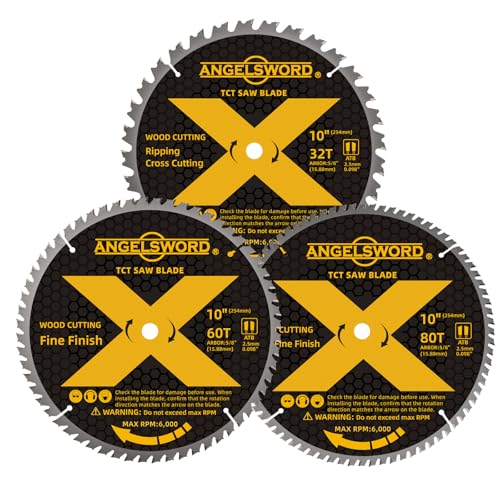
The ANGELSWORD 60-Tooth Ultra-Finish blade provides a versatile option for precise finishes when a balance between speed and surface quality matters. The 60-tooth geometry is enough for clean crosscuts and detailed joinery while still delivering reasonable material removal rates. The 0.098″ kerf and 5/8″ arbor ensure compatibility with standard table saws and consistent performance across a range of woods. Tungsten carbide teeth offer wear resistance and longer blade life in busy shop environments, making this blade suitable for furniture components, trimwork, and cabinetry where finish quality is a priority.
Best practices include using a sharp blade at an appropriate feed rate and ensuring proper blade alignment and tension. Pair this blade with a quality fence setup and dust collection to optimize surface quality and edge integrity over multiple pieces or batch productions.
Buying Guide: Key Purchase Considerations And Comparisons
When selecting a table saw blade, consider the following factors to align blade characteristics with project needs:
- Tooth count and finish quality: Higher tooth counts (60–90) favor smoother finishes and reduced tear-out, while lower counts (40–60) remove material faster but may produce rougher edges.
- Kerf width: Thin kerf blades minimize material loss and require less power, but are typically less forgiving if alignment or feed control is imperfect. Thick kerfs cut faster in some cases and are robust for heavy stock.
- Arbor compatibility: Most residential saws use a 5/8″ arbor. Always verify arbor size and flange compatibility before purchase to avoid vibration and incorrect seating.
- Material and tooth geometry: Carbide-tipped teeth offer longer life; advanced grind patterns (ATB, left/right bevel) affect cross-cut quality and tear-out behavior on various woods.
- RPM rating and blade thickness: Ensure the blade’s maximum RPM aligns with your saw’s capabilities. Warped or under-supported blades can cause chatter and poor finishes.
- Application focus: Choose blades optimized for finishing (ultra-fine, high tooth counts) when cabinetry and trim are the goal; select general-purpose or aggressive blades for framing and stock removal tasks.
- Durability vs. cost: Higher-quality blades tend to last longer and deliver consistent finishes, reducing rework and waste over time.
- Maintenance and care: Keep blades clean, honed, and properly stored; replace blades when teeth show chipping or dullness to maintain consistent results.
For most workshop environments, selecting a dedicated fine-finishing blade (80–90 teeth) for crosscuts and edge work, paired with a robust 60–80–tooth option for ultra-fine finishes, provides the broadest capability set. Consider having at least two blades on hand: one for finish work and another for general ripping or bevel cutting. Always follow safety guidelines, use proper PPE, and ensure the saw’s blade guard and riving knife are in place during operation.