Best 10 Inch Table Saw Blades for Clean, Precise Cuts
Choosing the right 10-inch table saw blade can dramatically impact cut quality, finish, and dust generation. This guide highlights five top-performing blades, comparing tooth geometry, kerf, and coating to help you pick the best blade for your shop. Whether you’re building cabinets, framing, or doing rough-cut work, these blades are designed for common American workshop tasks. The table below provides quick-reference specs for the chosen blades.
| Product | Brand | Teeth | Kerf | Arbor |
|---|---|---|---|---|
| Diablo D1050X | Diablo | 50 ATB | 0.098 in | 5/8 in |
| DEWALT DWA11080 | DEWALT | 80 | 0.098 in | 5/8 in |
| WEN BL1080 | WEN | 80 | 0.100 in | 5/8 in |
| WEN BL1060 | WEN | 60 | 0.100 in | 5/8 in |
| CMT 256.050.10 ITK XTreme | CMT | 50 ATB | 0.098 in | 5/8 in |
Diablo D1050X 10-Inch Blade

The Diablo D1050X is a versatile 10-inch blade designed for both ripping and crosscutting. It uses 50 teeth in a combination arrangement with a 15° hook angle, enabling efficient stock removal while also delivering smoother crosscuts. The blade employs TiCo carbide teeth, known for long edge life and good wear resistance, and it features a Perma-Shield non-stick coating to decrease heat buildup and resin buildup during plywood and melamine work. With a 0.098-inch kerf and a 0.071-inch plate, the D1050X balances aggressiveness with control, making it a solid choice for mixed workshop tasks where one blade handles many jobs. The 5/8-inch arbor aligns with most consumer and contractor saws, and the blade can reach up to 6,000 RPM, providing stable performance across typical shop applications.
- Best for mixed ripping and crosscut tasks
- Coated to reduce gumming and heat
- Solid all-around performance for solid wood, plywood, laminates
DEWALT DWA11080 10-Inch 80T Blade

The DEWALT DWA11080 is an 80-tooth, fine-finish blade built for high-quality finishes on both hard and soft woods. Its finer tooth count yields smoother faces with reduced tear-out, ideal for cabinetmaking and trim work. The blade uses a 5/8-inch arbor and is designed to run smoothly at high speeds (up to 6,000 RPM). While the exact kerf is not always advertised, DEWALT emphasizes life and precision through optimized tooth geometry, which helps preserve stock while delivering consistent finishes. The patented body slot design minimizes vibration, contributing to flatter cuts and less chatter in delicate facework.
- Excellent for fine finishing and cabinetry
- Low-vibration design improves cut quality
- Durable carbide tips for long life
WEN BL1080 80-Tooth Ultra-Fine Blade

The WEN BL1080 is designed for ultra-fine finishing with 80 carbide teeth and a thin kerf. It supports 5/8-inch arbors and is rated for up to 6,000 RPM, making it suitable for precise cabinet work and trim where a flawless face is required. The 0.100-inch kerf strikes a balance between material removal and heat generation, helping minimize burn marks on delicate woods and veneers. Carburized tips deliver long life, and the tooth geometry reduces chipping on plywoods and veneered panels. This blade excels when a premium finish is the priority without sacrificing too much speed.
- Best for ultra-smooth finishes
- Thin kerf reduces waste and heat
- Longer wear life with carbide teeth
WEN BL1060 60-Tooth Fine-Finish Blade
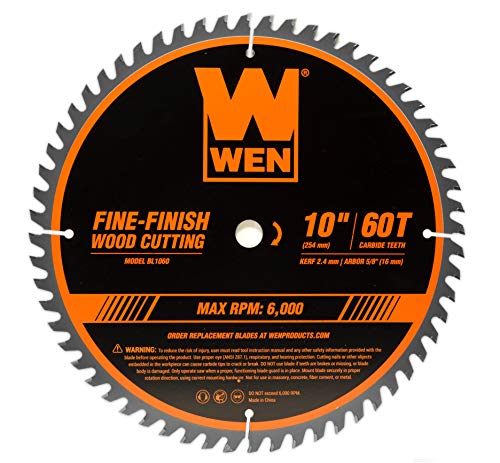
The WEN BL1060 blends finishing quality with efficient cutting. Its 60 teeth deliver a fine finish suitable for cabinetry and furniture components, while the 0.100-inch kerf preserves accuracy and reduces waste. The blade’s carbide tips provide durability and resistance to heat during extended cuts. The 5/8-inch arbor keeps it compatible with most table saws and miter saws found in American homes and professional shops, and the tooth profile helps minimize tear-out on veneers and plywood. This blade is a practical choice when you need more finish quality than a 40T blade but don’t require the maximum tooth count of an 80T blade.
- Balanced finish quality and cutting speed
- Ideal for cabinetry and furniture parts
- Durable carbide teeth for longer life
CMT 256.050.10 ITK XTreme XT 50T Blade

The CMT ITK XTreme 50T blade is marketed as an industrial-grade combination blade, designed for both ripping and crosscutting across varied wood products. It uses a 50-tooth ATB + flat grind configuration that provides efficient chip clearance via large gullets, enabling deep cuts in solid wood and plywood alike. The blade runs on a 5/8-inch arbor and features a 0.098-inch kerf with a thin plate, enabling faster cuts with less resistance. The 15-degree hook angle helps balance aggressive ripping with smoother crosscuts, and the flat-tooth configuration is well-suited for typical workshop tasks requiring versatility without swapping blades. This makes it a practical all-around blade for mixed-project shops.
- Versatile for ripping and crosscutting
- Large gullets improve chip clearance
- Combination blade suitable for multiple materials
Buying Guide
When choosing a 10-inch blade, consider how you typically work, the materials you cut most often, and the finish level you require. The following criteria help clarify blade selection and performance trade-offs for a typical American shop.
Tooth Count And Grind Type
- Lower tooth counts (40-50T) are aggressive for fast stock removal and rough cuts, but may leave rougher faces unless you’re using the blade for framing or rough carpentry.
- Mid-range counts (60T) offer a balance between speed and surface quality for cabinetry and furniture prep.
- High tooth counts (80T) excel at fine finishes, producing smoother faces on hardwoods and veneers but remove material more slowly.
- Grind geometry (ATB, FTG, or flat grind) affects tear-out, finish quality, and durability. ATB blades are common for crosscuts and laminates; flat-ground blades can be more durable for heavy ripping.
Kerf Thickness And Plate
- Thin kerf (around 0.098–0.100 in) requires less power and produces less waste, especially on smaller saws. It also runs cooler in many materials.
- Thicker kerf blades remove more material per pass but require more horsepower and can increase heat and burn risk in delicate woods.
- Blade plate thickness contributes to rigidity and stability; thinner plates may flex slightly under heavy cuts, affecting accuracy.
Arbor Size And Compatibility
- Most 10-inch blades use a 5/8-inch arbor, which matches the vast majority of consumer and contractor table saws. Always confirm your saw’s arbor size before purchasing.
- Some specialty or old saws may use different arbors; if needed, consider adapters or blades with compatible arbor options.
Coatings, Durability, And Finish Quality
- Coatings such as non-stick or anti-heat surfaces help reduce resin buildup and heat-related edge dulling, especially on melamine, plywood, or veneered panels.
- Carbide-tipped teeth extend blade life in tough woods, but tooth geometry and build quality influence edge retention and finish quality.
- Perimeter stability and vibration control (slot design, blade body construction) contribute to cleaner cuts, especially on long ripping passes.
Material And Task Fit
- Ripping-focused blades (fewer teeth, aggressive hook angles) are best for single-pass straight cuts in solid wood and framing lumber.
- Finishing-focused blades (80T, 60T) excel in cabinetry, trim, and veneer work, producing smoother faces and less tear-out.
- Combination blades aim to balance versatility for mixed tasks but may compromise finish quality if you routinely cut very fine materials.
Practical Comparisons
- Best finish quality: blades with 80T (for fine trim, cabinetry, and veneers) tend to yield the smoothest faces, especially on hardwoods and plywood.
- Best all-around value: a mid-range blade with 50–60T can handle a wide variety of cuts while offering reasonable finish quality and useful chip clearance.
- Budget considerations: blades with standard carbide tips and standard coatings can deliver reliable performance at a lower price point, though wear life may vary with wood type and cutting speed.
Across these five options, your choice should hinge on whether your priority is a finish-focused blade for cabinetry and furniture, or a versatile blade that handles mixed tasks without swapping blades mid-project. The included blades cover a spectrum from high-finish to balanced-performance profiles, helping you tailor your toolset to your workshop needs while keeping the workflow efficient and predictable.