Best Planers for Woodworking: Top Picks for Every Shop
Planers are essential tools for achieving flat, smooth surfaces on boards and mouldings. This guide presents five dependable options that cover both thickness planers and hand planers, suitable for different workloads and workshop sizes. Whether you’re smoothing tabletops, preparing stock, or trimming edges, these tools offer reliable cuts, durable construction, and straightforward blade changes. Read on to compare performance features and decide which model best fits your projects and budget.
When choosing a planer, consider motor power, cutting width and depth, blade design, and overall durability. The following selections emphasize different use cases—from compact handheld planers for detail work to full-size thickness planers designed for heavier stock removal. Each product highlights key features to help beginners and seasoned woodworkers alike make an informed choice.
| Product | Brand | Type | Notable Feature |
|---|---|---|---|
| DEWALT DW735X Thickness Planer | DEWALT | Thickness Planer | Two-speed gearbox; 30% longer knife life |
| WEN PL1252 Thickness Planer | WEN | Thickness Planer | Dual reversible blades; 20,000 cuts per minute |
| VEVOR Thickness Planer | VEVOR | Thickness Planer | Foldable stand; heavy-duty 2000W motor |
| Jorgensen 3.5-Inch Mini Planer | Jorgensen | Hand Planer | O1 tool steel blade; adjustable depth; ductile iron body |
| Jorgensen No.60-1/2 Mini Planer | Jorgensen | Hand Planer | Adjustable mouth; durable construction; precise trimming |
DEWALT Thickness Planer DW735X

The DEWALT DW735X is a robust thickness planer that emphasizes performance and efficiency. It uses a powerful 15-amp motor and delivers 20,000 revolutions per minute, with a cutterhead running at 10,000 rpm to handle larger cuts while maintaining surface quality. A three-knife cutter head is designed to extend blade life and simplify blade changes, helping reduce downtime between setups. A two-speed gearbox allows users to adjust the feed rate, optimizing cuts per inch for different stock and finishing requirements. This model targets professional shops and serious hobbyists seeking durable, repeatable results.
- Powerful 15-amp motor with 20,000 rpm motor speed
- Three-knife cutter head for longer blade life and easier changes
- Two-speed gearbox to tailor cuts per inch (96 or 179 CPI)
WEN PL1252 Thickness Planer
The WEN PL1252 delivers solid value for mid-sized projects and hobbyists. It can plane boards up to 6 inches thick and 12.5 inches wide, making it versatile for a range of stock sizes. Its 15-amp motor drives a cutter head capable of up to 20,000 cuts per minute at a feed rate of 26 feet per minute, ensuring fast material removal without sacrificing finish quality. The unit includes two reversible 12.5-inch blades (SK5), which help extend blade life and simplify replacement. This model balances performance with approachable pricing.
- Planes boards up to 6″ thick and 12.5″ wide
- 15-amp motor; 20,000 cuts per minute; 26 ft/min feed rate
- Two reversible 12.5″ SK5 blades included
VEVOR Thickness Planer
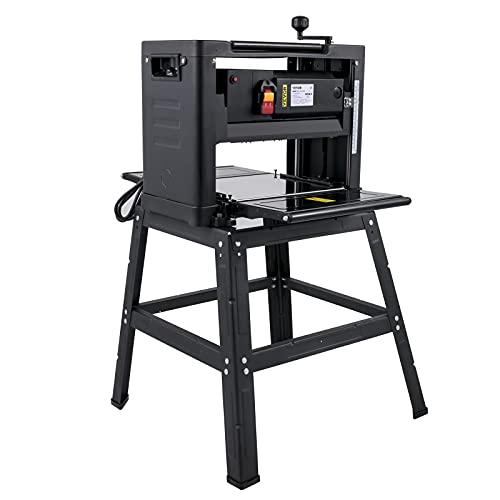
The VEVOR thickness planer is designed for affordable, practical woodworking in a home shop or light-commercial setting. Powered by a 2000-watt, 15-amp motor, it delivers up to 8,000 rpm and a steady feeding speed of 236 inches per minute (6 m/min). The machine supports a 13-inch cutting width with a planing depth of 0 to 0.12 inches and a maximum planing height of 6 to 160 millimeters. A foldable workbench and detachable stand add versatility in tighter spaces. An adjustable crank lets you raise or lower the cutter head, and a built-in scale helps you monitor thickness accurately.
- Powerful 2000W/15A motor; 8,000 rpm cutter head
- 13″ max width; 0-0.12″ planing depth; 6-160 mm height
- Foldable stand and adjustable crank-height cutter head
Jorgensen 3.5-Inch Mini Planer

The Jorgensen 3.5-Inch Mini Planer is a compact, hand-held option designed for precise trimming and small-scale manual planing. Its body is crafted from ductile iron for durability, and the blade uses professional-grade O1 tool steel to deliver clean, precise cuts with reduced wear. The blade is finely sharpened and can be sharpened or replaced for extended service life. An adjustable depth feature allows fine-tuning for varied woodworking tasks, while the mouth width can be adjusted to accommodate different stock profiles. This model suits detailed finish work and edge trimming in small projects.
- Professional O1 tool steel blade; highly sharpened
- Ductile iron body with zinc alloy lever cap and stainless components
- Adjustable cutting depth; adjustable mouth width for versatility
Jorgensen No.60-1/2 Mini Planer

The Jorgensen No.60-1/2 Mini Planer combines a compact footprint with robust construction. Like the other Jorgensen mini tool, it employs a ductile iron body and high-quality components for longevity in a small shop setting. The design emphasizes adjustability, with a mouth and depth controls that help users tailor the cut to each project. The blade is of professional quality steel and can be sharpened or replaced to maintain performance over time. Its portability makes it suitable for trimming, sizing, and fine edge work on small pieces or mouldings.
- Professional O1 blade; durable, consistent cuts
- Adjustable depth and mouth width for varied tasks
- Rugged ductile iron construction with high-grade components
Buying Guide
Choosing the right planer depends on work type, shop size, and desired finish. Here are critical factors to consider across both thickness planers and hand planers:
- Planer type and intended use: For large stock removal and even surfaces across wide boards, thickness planers like the DEWALT DW735X, WEN PL1252, and VEVOR are ideal. For detailed trimming, edges, and small parts, compact hand planers from Jorgensen cover precision work.
- Motor power and speed: Higher amperage generally supports heavier stock removal and faster production. Look for planers with at least 15A for thickness planers and assess cutter head speed to estimate finish quality and blade wear.
- Cutter head design and blade life: Three-knife systems can extend knife life and ease changes, while two-knife or single-knife systems may require more frequent maintenance. Material of the blade (O1 tool steel vs SK5) affects edge retention and re-sharpening frequency.
- Cutting width and depth: Wider boards require machines with larger cutting widths. Depth of cut determines how much stock you can remove in a single pass, which influences setup frequency and surface flatness.
- Adjustability and throat/mouth features: An adjustable mouth or throat helps reduce tear-out and supports planing difficult grain. For mini hand planers, depth control and mouth width adjustability improve accuracy on small pieces.
- Durability and materials: A ductile iron body generally offers robust rigidity and longevity, especially in heavier use. Stainless components and zinc-lead lever caps contribute to reliability in real-world shop conditions.
- Ease of blade changes and maintenance: Quick-change blade systems save downtime between setups. Availability of spare blades and sharpeners is also a practical consideration for ongoing projects.
- Portability and space: Hand planers are ideal for small workshops or portable projects, while larger thickness planers require more space and stable mounting but deliver consistent flattening on larger stock.
- Dust management: Integrated dust collection compatibility or robust dust extraction helps maintain a clean workspace and prolong tool life.
In practice, a well-rounded kit may include a robust thickness planer for bulk stock removal and a precise hand planer for finish work and trimming. The five models reviewed here offer representative capabilities across price and performance tiers, enabling woodworkers to select based on project scope, budget, and workspace size. Regardless of choice, proper blade maintenance and safe operation remain essential for achieving high-quality results and extending tool life.