Best Sewer Gas Detector for Home and RV Safety
Sewer gas leaks pose serious safety risks in confined spaces, from homes and basements to RVs and workshops. Gas detectors that can sniff common sewer-associated gases such as methane and hydrogen sulfide, while offering easy access to hard-to-reach pipes, are essential for prevention. This guide highlights five highly capable detectors that balance accuracy, portability, and clear alerts. Each option below prioritizes rapid response, reliable alarms, and practical use in everyday settings. Use this overview to compare how each model fits your space, gas concerns, and power needs.
| Product | Brand | Best For | Key Feature |
|---|---|---|---|
| Portable Sewer Gas Detector With 12-Inch Probe | EG | Hard-to-reach areas | 12″ flexible probe; wide range of combustible gases; 85 dB alarm |
| Sewer Gas Detector For Home And RV | Xalire | Home and RV safety | AC plug-in with LED display; 85 dB alarm; sewer gas detection |
| Guard-101 Four-Gas Monitor | TOPTES | Professional multi-gas monitoring | H2S, CO, LEL, O2 detection; vibration, visual and audible alarms |
| Klein Tools ET120 Gas Leak Detector | KLEIN TOOLS | Long-reach detection | 18″ gooseneck; 50-10,000 ppm range; 85 dB alerts |
| NICGOL 4-in-1 Gas Detector | NICGOL | Plug-in home safety | 4-in-1 natural gas and CO, with temperature and humidity |
Portable Sewer Gas Detector With 12-Inch Probe

EG’s gas leak detector is designed to identify a broad spectrum of combustible gases, including sewer gas. The standout feature is a 12-inch bendable gooseneck that reaches tight spaces around pipes, fittings, and concealed gaps. An 85 dB alarm paired with a six-LED indicator system provides immediate, at-a-glance information about gas presence and concentration. This model is versatile for home garages, basements, RVs, and light industrial spaces where access is limited yet quick detection is essential.
- Detects methane (natural gas), propane, butane, ethanol, alcohol, gasoline, kerosene, sewer gas, and more.
- 12-inch flexible gooseneck probe reaches confined spaces and pipework.
- 85 dB audible alarm with six LED indicators to display gas concentration levels.
Sewer Gas Detector For Home And RV

Xalire’s detector is tailored for both home and RV safety, with a plug-in design that ensures constant readiness. It detects multiple flammable gases, including methane, propane, LPG, LNG, butane, and sewer gas, and displays readings on a real-time LED interface. The 85dB alarm provides a robust audible warning, while the LED readout helps occupants quickly assess gas levels. This unit is well-suited for kitchens, basements, storage spaces, and mobile living areas where space is at a premium but safety remains a priority.
- Versatile gas detection for methane, propane, LPG, LNG, butane, alcohol, coal gas, sewer gas, and more.
- AC plug-in power with real-time LED display for quick readings.
- 85 dB alarm provides clear audible warning in noisy environments.
Guard-101 Four-Gas Monitor
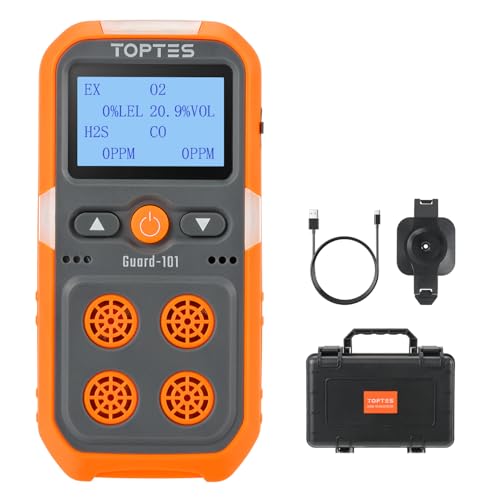
The TOPTES Guard-101 is a compact, explosion-proof multi-gas monitor designed for quick, reliable detection of four gases: hydrogen sulfide (H2S), carbon monoxide (CO), lower explosive limit (LEL), and oxygen (O2). It delivers rapid readings (as fast as 0.5 seconds) with three alarm modes: visual LED indicators, audible alerts, and vibrations. Battery life runs up to 14 hours, making it suitable for extended field use in industrial facilities, work sites, and safety-critical environments where methane and sewer gas risk may be present. Data storage adds traceability for compliance or inspections.
- Detects H2S, CO, LEL, and O2 with a fast 0.5-second response.
- Three alarm modes: LED, vibration, and sound; back-clip for portability.
- Up to 14 hours of operation; rugged ABS housing; data storage for monitoring records.
Klein Tools ET120 Gas Leak Detector

The Klein Tools ET120 emphasizes reach and precise monitoring with an 18-inch gooseneck. It covers a broad detection range from 50 to 10,000 ppm, making it versatile for both residential and commercial inspections. Adjustable sensitivity allows users to tailor detection to the environment, while five red LEDs and the 85 dB audible alert provide clear, escalating warnings as gas concentrations rise. Its portable design makes it ideal for inspections around basements, crawl spaces, attics, and HVAC systems where leaks often hide.
- Detection range approximately 50 to 10,000 ppm (methane baseline).
- Adjustable sensitivity for appropriate responses in varied spaces.
- Five red LEDs and an 85 dB alarm intensify with gas concentration.
NICGOL 4-in-1 Gas Detector

NICGOL’s upgraded 4-in-1 detector combines natural gas sensing with carbon monoxide monitoring and environmental data. Designed for home and RV safety, it operates as a plug-in unit with low power consumption and dual alarms to ensure visibility and audibility. While it emphasizes gas and CO detection, the device’s dual sensor setup helps provide reliable coverage across typical indoor risk scenarios, including basement or storage areas where sewer gas may accumulate. The integrated temperature and humidity readings offer additional context for gas behavior in changing conditions.
- 4-in-1 detection: natural gas, CO, temperature, humidity.
- Dual alarms for fast, clear alerts; energy-efficient plug-in design.
- Compact, easy installation for homes and RVs.
Buying Guide: Key Purchase Considerations And Comparisons
Choosing the right sewer gas detector requires balancing gas targets, environment, and practicality. Below are essential considerations and how they relate to the models covered above.
- Gas targets: If hydrogen sulfide (H2S) and methane are your primary concerns in confined spaces, prioritize multi-gas monitors with H2S and LEL sensing, such as guards like Guard-101. For home settings where sewer gas and general leaks are a concern, detectors that explicitly mention sewer gas or multiple flammable gases (like the EG and Xalire options) provide broader coverage.
- Detection range and speed: Look for devices with fast response times (0.5 seconds is common on professional units) and a wide ppm range. That ensures you detect both minor leaks and larger releases quickly.
- Alarm modality: A combination of audible, visual, and optional vibration helps ensure alerts are noticed in noisy environments or while you’re wearing hearing protection. Most models in this guide offer 85 dB or higher alarms and LED indicators for gas levels.
- Power and portability: Plug-in detectors provide constant power but may be less portable for RV or vehicle use. Battery-powered devices or those with back-up batteries (for power outages) offer more flexibility in mobile contexts. The Guard-101 and Klein Tools ET120 emphasize portability, while Xalire emphasizes continuous power for home use.
- Use-case alignment: For long inspections or RV travel, a detector with a long reach (18-inch gooseneck) or a flexible probe can save time and improve accuracy. For fixed locations like basements, a plug-in detector with good LED readouts is convenient.
- Durability and safety certifications: Look for robust housings and, if needed, explosion-proof or water/dust-resistant designs for harsh environments. Guard-101 notes rugged construction and multiple protection features, which is valuable in industrial settings.
- Maintenance and calibration: Some detectors require calibration or sensor replacement after extended use. Consider models with clear indicators for low battery or calibration needs. Battery life varies by model; Guard-101 can last up to 14 hours under active use, while plug-in units remove this concern but rely on constant power.
- Data logging and traceability: For workplaces and compliance-focused installations, devices with data storage or memory let you review past detections and alerts. This feature is present in some multi-gas monitors and adds a layer of accountability for safety protocols.
- Environmental suitability: If you frequently monitor RV interiors or mobile setups, select detectors with compact form factors and integrated mounting options. For home basements, wall outlets and constant power supply models are often more practical.
- Price-to-performance balance: Multi-gas monitors with H2S and CO detection tend to sit at a higher price point. If your needs are specific to sewer gas plus general leaks, models like EG or Xalire offer strong value without compromising core safety features.
In summary, the best detector for you depends on whether you prioritize portability, the breadth of gas sensing, alarm versatility, or power options. For comprehensive protection in homes and RVs where sewer gas and similar hazards might occur, combining a multi-gas monitor (Guard-101) with a flexible, reach-focused detector (EG or Klein Tools ET120) offers robust coverage. If you want a plug-in solution with continuous operation and clear readouts, Xalire provides an accessible option for longer-term safety monitoring.