Best Refrigerant Leak Detectors for Home and Professional HVAC Use
Choosing a refrigerant leak detector helps HVAC pros and homeowners locate leaks quickly, protect system efficiency, and ensure safety around potentially hazardous gases. Infrared sensors deliver fast responses and broad halogen-gas coverage, while heated-diode units offer time-tested reliability and strong sensitivity for all common refrigerants. This guide presents five well-rounded detectors that balance sensitivity, durability, and user-friendly features. Use the quick table below to compare the essentials at a glance, then read detailed sections to understand how each model fits different applications.
| Product | Brand | Notable Feature |
|---|---|---|
| Elitech ILD-200 | Elitech | Infrared, long sensor life, wide halogen gas range |
| SENSYX SFD201 | SENSYX | Rechargeable, high sensitivity, compact for mobility |
| Fieldpiece DR58 | Fieldpiece | Heated diode, ultra-sensitive, 300-hour sensor life |
| Fieldpiece DR82 | Fieldpiece | Infrared, 10-year sensor life, broad refrigerant compatibility |
| TOPTES RT-389 | TOPTES | Three sensitivity modes, 14.5″ gooseneck, TFT display |
Below are five options that cover a spectrum of detection technologies, reliability, and practical features relevant to both DIY homeowners and professional HVAC technicians.
Elitech ILD-200 Refrigerant Leak Detector
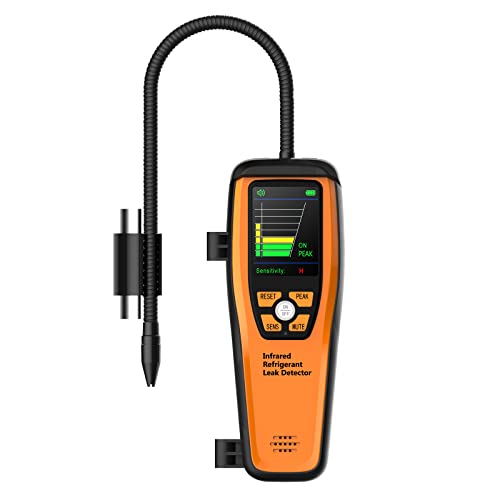
The ILD-200 uses an infrared sensor designed for robust anti-interference performance and rapid response. It’s calibrated to detect a broad range of halogenated refrigerants and blends, making it suitable for service on automotive AC and residential systems alike. The unit emphasizes long-term durability, with an infrared sensor life rated for years of operation, and an adjustable sensitivity setting that tops out at 0.14 oz/yr, enabling technicians to tune detection to the leak environment.
Key considerations and strengths include its ability to handle multiple halogenated refrigerants (CFCs, HFCs, HCFCs, HFOs) and common blends such as R22, R410A, and R600a. Technicians will appreciate the quick readiness and the clear feedback that infrared sensing provides, especially when tracing leaks through dense insulation or in tight spaces. The ILD-200 is well-suited for regular maintenance checks, refrigerant recharge verification, and fast locational work in both automotive and building systems. Its field performance is often highlighted by consistent readings even in challenging ambient conditions.
SENSYX SFD201 Refrigerant & Combustible Gas Detector

The SFD201 from SENSYX centers on a rechargeable design for cordless operation, with a USB-C charging option that supports field work without constantly hunting for power outlets. Its sensor line includes a Japan-made heat dioxide semiconductor, which provides strong sensitivity in detecting common halogen refrigerants. The device offers adjustable sensitivity levels (High/Low), enabling technicians to tailor detection thresholds to the immediate environment—especially useful in crowded equipment rooms or on automotive systems with mixed refrigerants.
In practical terms, the SFD201 emphasizes portability without sacrificing core detection capabilities. The rechargeable battery helps keep tools ready for service calls or long-term diagnostics, while the sensor’s reliability supports consistent leak verification across CFCs, HCFCs, HFCs, and HFOs. For shop use or field work where quick, repeatable readings matter, the SFD201 provides a balanced combination of mobility and dependable sensitivity, with the added advantage of a compact form factor that fits into tight tool bags or HVAC service kits.
Fieldpiece DR58 Heated Diode Refrigerant Leak Detector

The DR58 is a proven heated-diode detector designed for quick, highly sensitive leak checks. It identifies micro leaks at levels below 0.03 oz/yr, delivering rapid feedback on leak paths in worn joints, connections, or complex HVACR assemblies. It is compatible with all refrigerants—CFCs, HCFCs, HFCs, HFOs, and blends—making it a versatile tool for service shops and field technicians alike. The sensor is IP54-rated, offering resistance to moisture and oil exposure for tough job sites, and Fieldpiece rates the sensor life at around 300 hours of use, which supports extended field work before routine maintenance is required.
Practically, the DR58’s strength lies in its immediate, tactile feedback and straightforward operation. The heated diode approach often yields clear, directional readings, helping technicians locate leaks quickly in automotive AC systems and larger commercial setups. Its rugged build, combined with a simple user interface and audible/visual alerts, makes it a favored choice for technicians who prioritize speed and reliability in challenging environments.
Fieldpiece DR82 Infrared Refrigerant Leak Detector

The DR82 combines Fieldpiece’s infrared sensing with a backlit LCD to deliver clear readings in varying lighting conditions. It detects micro leaks quickly, with a sensitivity target of less than 0.03 oz/yr, similar to other top infrared detectors. The sensor design is durable and built to last, with IP54 protection to resist moisture and oil exposure in tough field conditions. A long-term reliability edge comes from Fieldpiece promoting a 10-year sensor life—an attractive feature for teams that rely on durable gear for daily service calls, especially when testing multiple systems in a single day.
Users appreciate the broad refrigerant compatibility, covering CFCs, HCFCs, HFCs, HFOs, and blends used across automotive, residential, and commercial equipment. The DR82’s combination of sensitive infrared sensing, durable construction, and extended sensor life makes it a strong all-around choice for technicians who need a dependable tool that performs well in busy service environments or busy shop floors where quick confirmation of leaks matters most.
TOPTES RT-389 Rechargeable Refrigerant Leak Detector

The RT-389 from TOPTES blends an advanced Japanese semiconductor sensor with impressive flexibility. It offers three sensitivity modes—High, Middle, and Low—so technicians can precisely identify leaks at different intensities. The detector’s stated maximum sensitivity reaches 3 g/yr (roughly 0.1 oz/yr), providing a balance between fast, broad detection and careful measurement when needed. A 14.5-inch flexible gooseneck helps reach automotive manifolds, furnace cabinets, humidifiers, and other tight spaces where leaks often hide.
Additional strengths include a 2.8-inch TFT color display for accessible readings, a quick-mute function to silence alarms during focused inspections, and multiple alarm types (sound, visual, vibration) to suit noisy environments or when working around clients. TOPTES also integrates a top light for visibility in dim spaces, aiding accuracy in basements or garages. The RT-389 is a versatile choice for technicians who perform residential, commercial, and automotive leak checks and value flexible notification alongside clear visual data.
Buying Guide
When selecting a refrigerant leak detector, several factors determine which model best fits your needs. The choice often comes down to sensor technology, detection sensitivity, gas coverage, and how you’ll use the tool—whether for quick spot checks, detailed localization, or regular service calls.
- Sensor technology: Infrared detectors excel in fast, broad detection across many halogenated refrigerants, with robust anti-interference characteristics. Heated-diode detectors are typically simple, reliable, and highly sensitive to trace leaks, making them popular for automotive and small-to-medium HVACR jobs.
- Detection sensitivity: Look for the maximum detectable leak rate, often expressed in oz/yr or g/yr. Higher sensitivity helps in early leak detection but may increase the chance of false positives in certain environments. A detector with adjustable sensitivity provides flexibility for both large and tiny leaks.
- Gas coverage: Ensure the device detects all common halogenated refrigerants (CFCs, HCFCs, HFCs, HFOs) and blends you encounter, including refrigerant mixtures used in modern systems and blends like R410A or R134A.
- Display and alarms: A clear display (TFT or backlit LCD) helps readouts in bright or dark spaces. Audible alarms, visual indicators, and vibration alerts are useful in noisy environments or service bays.
- Build quality and durability: IP ratings (like IP54) indicate protection against moisture and oils. A rugged housing, reliable sensors, and long service life reduce downtime on job sites.
- Probe design and reach: A flexible gooseneck or long probe aids in evaluating tight spaces around compressors, evaporators, and automotive components. A longer reach often saves time when diagnosing in confined areas.
- Power options: Rechargeable batteries with USB-C or standard batteries affect portability and uptime. Consider whether you need field-ready cordless operation or a device that can be quickly swapped or recharged at a shop.
- Calibration and maintenance: Some detectors require periodic calibration or sensor replacement. Review the expected sensor life and maintenance needs to avoid unexpected downtime.
- Portability and price: For DIY users or smaller shops, a compact, cost-conscious model with solid performance may be preferable. For service fleets, investing in a higher-durability, higher-sensor-life model can reduce replacement costs over time.
- Warranty and support: A longer warranty and responsive customer support can be valuable, especially for professionals who rely on their tools daily.
Quick Comparison Snapshot
| Product | Sensor Type | Max Sensitivity | Notable Strength |
|---|---|---|---|
| Elitech ILD-200 | Infrared | 0.14 oz/yr | Strong anti-interference; long sensor life |
| SENSYX SFD201 | Semiconductor (Japan-made) | Adjustable levels | Rechargeable; portable |
| Fieldpiece DR58 | Heated Diode | 0.03 oz/yr | 300-hour sensor life; IP54 durability |
| Fieldpiece DR82 | Infrared | 0.03 oz/yr | 10-year sensor life; broad compatibility |
| TOPTES RT-389 | Semiconductor | 0.1 oz/yr (3 g/yr) | 14.5″ gooseneck; TFT display; triple alarms |
Choosing the right detector depends on your typical workloads. For automotive technicians performing frequent, tight-space checks, a detector with a long reach and a reliable alarm system is essential. For residential or commercial HVAC work, a detector with broad gas coverage, strong durability, and clear digital readings helps streamline leak localization and verification. If you primarily handle periodic maintenance or calibration checks, a model with long sensor life and straightforward operation can minimize downtime and maintenance costs. These five options provide a spectrum of capabilities to suit different environments and budgets while maintaining robust leak-detection performance.