One crowded evening can make an entire week of meal planning feel larger than it needs to be. You might know that Tuesday has a late return, an early departure, and a small window to eat, but still leave the actual food decision until everyone is standing in the kitchen.
Start with that evening rather than designing a perfect seven-day menu. Choose one familiar meal that fits the time and the people who will be home, then work backward through the ingredients, preparation, handoff, and cleanup that make the choice possible.
Name the evening’s real constraints
Look at the household calendar and describe when people are available, rather than treating the dinner hour as a fixed block. Someone may arrive after others have left, another person may have a short break, and the person who usually cooks may not be home at all.
Separate time in the house from time available to prepare food. Returning at six does not necessarily mean you can begin cooking at six, especially when you also need to put things away, help someone else, or get ready for another commitment shortly afterward.
Write down the constraint in one useful sentence, such as needing a familiar meal that can be prepared by the person already home before the next departure. That sentence gives you a more practical starting point than asking what everyone wants to eat while several other decisions remain unresolved.
Include your actual budget and available equipment without making either a moral test. A plan that requires a special purchase or an appliance you do not have is a different plan, and you can choose something ordinary that fits your kitchen instead of trying to recreate someone else’s week.

Choose something you already know how to make
For this one busy evening, start with a meal whose steps you understand. You can save a new recipe for a day when you want to read the instructions carefully, confirm the ingredients, and find out how the preparation fits your own kitchen.
The Mississippi State University Extension meal-planning guide explicitly includes cooking ability and available time when choosing meals. Its practical point supports matching the task to your evening; it does not require you to copy its sample meal or nutrient amounts.
Ask what the meal requires beyond the main dish. A familiar choice can still involve several separate pans, a missing side, or a last-minute task that only one person knows how to do, so picture the whole sequence before treating it as an easy option.
If two meals both fit, choose the one with fewer unresolved decisions that week. You are not declaring a permanent family favorite; you are reducing the number of questions that must be answered during a particularly narrow window on a particular day.
Check the actual ingredients before writing the list
Look at what you have rather than relying on the memory that a package was in the cabinet last week. Confirm that the specific ingredients for the chosen meal are available and suitable for use, following the product’s storage and handling instructions where relevant.
Write a shopping list from that check, keeping the busy-evening meal visible as a complete choice. If you substitute an ingredient, make sure the person preparing the meal knows about the change and has an appropriate recipe or familiar method for what will actually be available.
Do not add an extra dish solely because an ingredient is on sale or because the plan looks too plain on paper. You can enjoy variety across ordinary meals without making the most crowded night carry every food idea you would like to try that week.
If you intend to use previously cooked food, establish its handling and storage before relying on it for the plan. A note on the calendar does not determine whether leftovers remain appropriate, and a future meal idea should not override the actual food-safety guidance for the food involved.
Assign the handoff, not just the menu
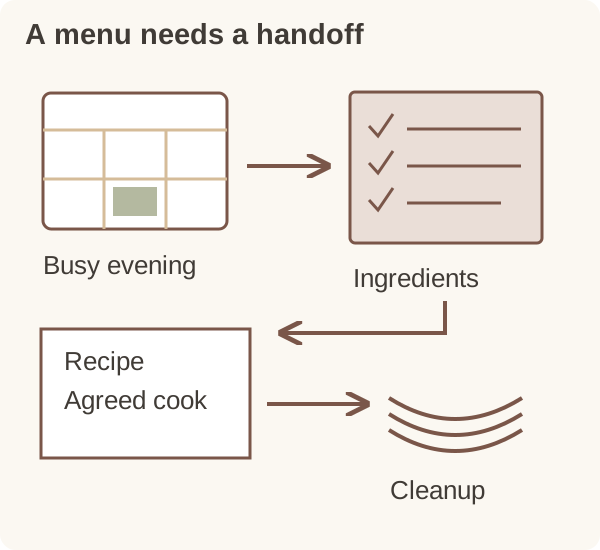
A written menu leaves important work invisible if it does not say who will prepare it or where the instructions are. Agree with the person involved rather than placing their name beside a task and assuming that seeing the calendar counts as accepting the assignment.
Keep the handoff concrete: what will already be done, what still needs to happen, and where the needed information can be found. If the first person only buys the ingredients, say so, because another person may otherwise assume that preparation is part of the same promise.
Use a brief note that matches the actual meal rather than copying a general checklist every week. A familiar recipe name and its location may be enough for one household, while another needs the chosen ingredient substitutions recorded beside the original instructions.
Include the work after eating
Think through what the kitchen needs to look like before the next activity begins. If you will leave soon after eating, a meal that uses several pieces of equipment may create a cleanup problem even when the cooking itself fits the available time.
Discuss cleanup with the same specificity as preparation. Clearing the eating surface, washing the cookware, and putting food away are different parts of the job, so make sure your agreement covers the actual work instead of using a broad promise that means different things to different people.
The Extension guide includes purchasing, preparing, setting the table, clearing, dishes, and appropriate leftover storage among meal responsibilities. You can use that broader view when dividing tasks without assuming that every household member has the same availability, ability, or role on the busiest evening.
Keep the plan adjustable if someone cannot do the task they expected to handle. A simple message before the narrow meal window is more useful than discovering the gap afterward, and the alternative can be a different ordinary meal rather than a hurried attempt to preserve the original menu.
Choose a fallback you can actually carry out
Decide what would make you change the plan, such as an unexpected late return or a necessary ingredient not being available. Choose a practical alternative in advance, with its own required ingredients and handling, instead of writing a vague instruction to figure something out.
The fallback might be another familiar meal or an option you have deliberately budgeted for. It should fit your household’s needs rather than serve as a punishment for the evening going differently, and everyone involved should know when the change has been made.
Avoid promising that preparing food in advance is always the easier option. Some meals and schedules suit that approach, but the actual storage, reheating, equipment, and handoff requirements still need to fit; convenience is a question to work out for the specific meal rather than an automatic result.
Keep one observation for the following week
After the evening, record the detail that affected the plan most. You might learn that a departure time was earlier than expected, that one step needed another person, or that cleanup took the available gap even though the meal itself was familiar.
Change that detail next time instead of rewriting the whole household menu. A useful meal decision gives you a manageable answer for one crowded evening, along with enough information to repeat or revise it, while leaving the rest of your week open to ordinary choices.
For example, you may learn that the meal choice was fine but nobody had agreed to check the shopping list before leaving the house. Keep that observation attached to the handoff so next week’s adjustment addresses the actual gap.
