A plan for rest can quietly become another full schedule of household expectations. You decide that a certain day should feel slower, then fill the preceding evening with preparation and leave one person responsible for keeping the slower day running while everyone else enjoys it.
Begin by defining the space you want to leave open and the work that still needs to happen. You can make a modest agreement about one part of a day without prescribing a religious observance, promising a health outcome, or expecting your household to share an identical idea of rest.
Name the time you want to leave open
Choose a realistic period rather than assuming that an entire calendar day is available. Work schedules, caregiving, transportation, and other commitments may shape what is possible, and naming a smaller window can lead to a more useful agreement than beginning with a day nobody can protect.
Describe what you hope to make room for in ordinary words. You may want an unhurried meal, a quiet afternoon, a walk, worship, or time without a particular kind of project, and those choices are different enough that the household should not have to infer your meaning from the word rest.
Ask the other people involved what they are hoping for before arranging the room or assigning preparation. One person may want company while another wants solitude, and it is easier to discuss the difference before a shared plan has already been presented as the answer.
Keep your first agreement small enough to revise. Protecting one interval from an optional project can be a useful beginning, while trying to change every weekend habit at once may create more negotiation than the opening you actually wanted in the first place.

Separate necessary work from optional projects
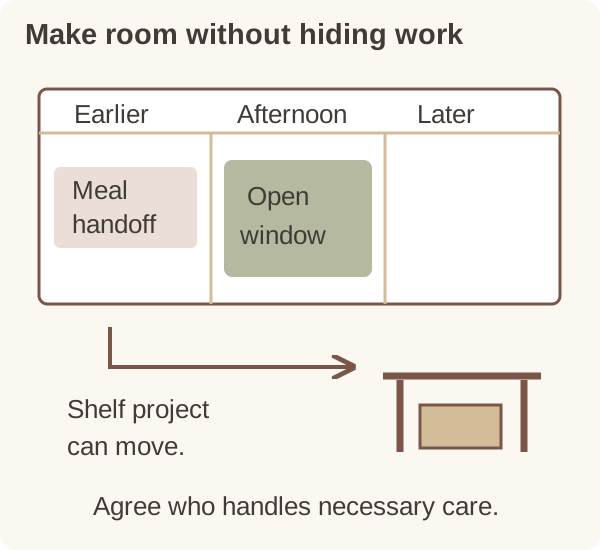
List what genuinely needs to happen during the chosen window before deciding what to postpone. Meals, care responsibilities, and time-specific commitments do not disappear because you prefer a slower afternoon, so include them plainly rather than allowing them to become invisible work for someone else.
Then identify tasks that could move without creating another problem. Sorting a decorative shelf might wait, while a responsibility involving another person’s agreed needs may require an actual handoff, and those decisions deserve more attention than simply labeling all household work as something to avoid.
For each necessary task, ask who has agreed to handle it and whether that arrangement leaves them any of the space you are trying to create. A shared plan should not depend on one person quietly absorbing every interruption while the rest of the household regards the day as free.
If responsibilities cannot be shared in the same way that week, acknowledge the situation directly. You may need different rest windows for different people or a smaller common interval, rather than treating a single synchronized day as the only meaningful result.
Limit the preparation before the day
Preparation can help, but give it an edge so it does not expand indefinitely. Decide which small tasks actually support the planned interval and which ones merely reflect an imagined picture of how the house should look before anyone is allowed to slow down.
A useful preparation might be agreeing on a familiar meal or finding the book you intend to read. Reorganizing an entire cupboard because you plan to serve that meal is another project, and you can leave it outside the preparation list unless it is truly necessary.
Use the same fairness check for advance work that you use for the day itself. If one person’s evening becomes substantially busier so another person can have an empty afternoon, discuss that trade rather than allowing the word preparation to hide how the arrangement affects everyone.
Choose a stopping point based on the actual support you need. When the agreed meal information and immediate materials are ready, you can stop without finishing every visible task in the room, leaving the home recognizable as a place people continue to use.
Allow different ways of using the opening
You do not need everyone to choose the same activity for the agreement to work. One person might read while another sits outside, and a shared meal can be the meeting point between those choices instead of the beginning of a full sequence everyone must follow.
If quiet is important, discuss what it means in the actual shared room. You might agree on headphones for one activity or use different spaces, while avoiding a rule that assumes every household member can simply stop making noise or leave whenever another person wants silence.
When faith shapes your plan, explain the part that belongs to your own observance and ask how the shared household arrangement can respect it. You can make space for worship or reflection without declaring that people with different schedules, traditions, or beliefs must participate in exactly the same way.
University of Minnesota Extension’s discussion of new family traditions emphasizes communicating expectations and approaching differences flexibly. Its context is newly formed families; that narrow planning principle can inform your conversation without making the source an endorsement of a particular rest-day practice.
Decide what happens when the day changes
Talk about likely interruptions before the interval begins. A necessary call, an unexpected care need, or a changed work schedule may require a different plan, and you can decide which parts remain possible without describing the whole day as ruined by one change.
Avoid making a person ask permission to meet a real responsibility. The purpose of the agreement is to clarify ordinary choices around the opening, not to turn the rest plan into a rule that blocks needed care or pressures someone to hide the fact that their day is different.
If the shared interval no longer works, choose a smaller alternative or separate windows where possible. A brief quiet moment later may still be useful to you, while insisting on restoring the original plan can create a second project on top of the unexpected work.
Keep unfinished optional tasks somewhere you can find them without bringing them back into the open interval. A note for another day can hold the idea, allowing you to decide later whether it still deserves time rather than repeatedly discussing it during the period you meant to leave unfilled.
Review the agreement without grading the day
Afterward, ask one practical question about the arrangement: what helped create the intended space, and what work was still unclear? The answer may concern timing or division of responsibility rather than whether anyone achieved a particular feeling or used the opening in a visibly productive way.
Let people describe their experience without comparing whose choice counted as real rest. A quiet afternoon, a social visit, and an unhurried household activity can mean different things to different people, and your shared plan can focus on the responsibilities and boundaries you actually agreed to manage.
Keep one adjustment for next time, such as a clearer meal handoff or a shorter protected window. A practical rest-day plan leaves room in ordinary life while keeping necessary work visible, and it can remain flexible enough to fit the people and week in front of you.
For example, you might discover that the open afternoon worked but the evening reset still had no agreed owner. Keep the useful interval and discuss that specific handoff, rather than deciding that the whole idea failed or requiring someone to do all the work earlier next time. A small adjustment should address the real gap.
