Household papers often arrive with different jobs hidden inside the same pile. A school notice needs a calendar decision, a warranty belongs with a product record, and a personal statement may need protected storage rather than a place on the shared kitchen counter.
A capture spot gives incoming paper a place to wait while you decide what each item needs. It is an entry point for ordinary household coordination, not a rule that every document belongs together or that a tidy-looking stack has already been dealt with.
Notice where paper really enters the home
Follow the usual route of mail, bags, folders, and receipts before choosing a container. If papers arrive through two different doors or travel in someone else’s work bag, a single attractive tray may miss half the flow unless you agree on how the papers reach it.
Choose a location that the people involved can recognize and use without being expected to read private material. A shared surface can hold ordinary notices, while sensitive documents need an appropriate separate arrangement that reflects their contents and who should have access.
Start with a small group of new arrivals rather than moving every old stack into the new spot. You will learn more about the incoming routine by watching what happens to this week’s papers than by creating one much larger pile whose original jobs remain unclear.
Name the place simply, such as incoming household papers, and explain what the name means. It should tell someone where to put a routine notice without implying that placing it there automatically adds an event to the calendar or transfers responsibility to another person.

Separate arrival from the next action
When a paper arrives, ask what decision it requires before choosing a storage destination. You might need to respond, record an event, keep information for reference, or establish whether the item can be discarded, and those are different tasks even when the papers are similar sizes.
Use a plain note for an action that cannot happen immediately. Write who has agreed to handle it and the actual deadline shown on the document when there is one, rather than inventing an earlier household date that someone may mistake for the official requirement.
If a notice contains an event, enter the necessary information in your agreed calendar and check what else must happen. A date alone may not capture transportation, required materials, or permission that the original paper asks for, so do not discard the source before its job is understood.
Keep the capture spot from turning into a second calendar that only one person knows how to read. The useful action should move into the system your household already uses, while the paper itself goes to its appropriate next place once you have established what it needs.
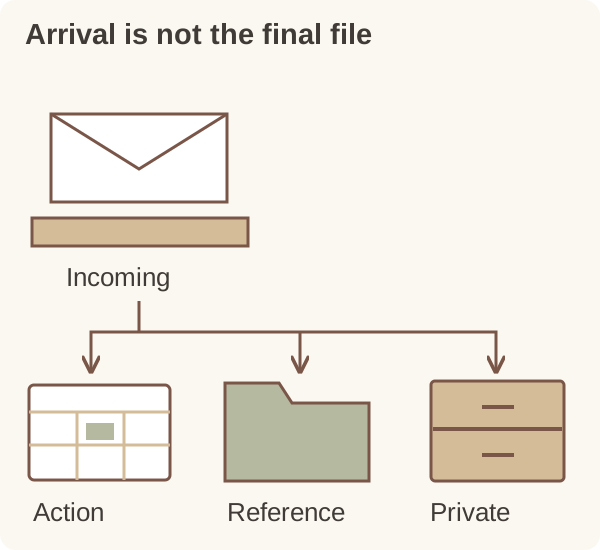
Give sensitive records a different route
Look at the contents before leaving a paper where guests or unrelated household members can see it. A financial statement, identification document, or personal correspondence can need a different audience from a community flyer, even if all four entered through the same mail slot.
The Federal Trade Commission’s document guidance identifies important records to retain and lock up, and advises shredding papers with personal or financial information when it is time to dispose of them. An open capture tray is not a substitute for that protected record storage.
Decide which people need access to the shared action rather than handing over the entire document by default. A calendar reminder that a response is due may be useful to the household without displaying the personal details that appear elsewhere on the original paper.
If a record concerns another adult, agree on how it will be handled instead of assuming that sharing a home gives you permission to open, scan, or file it. The capture routine can respect that boundary by leaving personal mail with its intended recipient and keeping the shared process narrow.
Do not let tidying set a retention rule
A small container can help limit clutter, but its capacity does not determine whether you should keep a document. If the tray is full, make the pending decisions or improve the process rather than choosing papers to discard solely because you want the surface clear.
Retention depends on the kind of record and your actual situation. Consult the relevant official guidance or qualified adviser for documents with tax, legal, financial, or other obligations instead of applying one household rule to every item that happens to look old.
The FTC page itself notes that some tax-related records may need to be kept longer than its basic category suggests. That qualification is a reason to read the relevant record-specific requirements, rather than treating a short article or a folder label as a complete retention schedule.
Keep uncertain items in an explicitly marked review category while you find the answer. A brief note about the unresolved question is more useful than silently leaving the paper in the incoming pile, where another person may reasonably think it has never been considered at all.
Choose digital copies deliberately
Scanning a page creates another record to manage, so decide why you need the copy before making it. You might want an accessible reference for a current task, but that does not automatically settle whether the original must stay or where the digital version should be stored.
Use a file name you can recognize later, with a date or subject that describes the actual document. Avoid adding unnecessary sensitive details to a name that may appear in notifications, shared folders, or search results, especially when the full contents already require restricted access.
Check the destination and its sharing settings before uploading a sensitive page. A convenient folder selected by an app may not be the folder you intended, and the fact that you can find the file does not establish who else can open it.
Keep digital handling separate from permission to destroy the original. Establish the requirements for that specific record first, then decide what should happen to the paper and the copy rather than assuming that a readable photograph completes every obligation attached to the document.
Create a review moment that closes the loop
Choose a review time that someone has actually agreed to use, whether that is after sorting the mail or during another ordinary household check-in. The purpose is to move papers through their jobs, not to produce a perfect stack that will need the same sorting again next week.
At that review, identify the next action, confirm any handoff, and move the item to its appropriate destination. If you are waiting for another person’s decision, make that visible in the agreed system instead of burying the paper beneath unrelated arrivals that will obscure the reason it remains.
Notice repeat problems rather than buying more compartments immediately. Several event notices waiting in the tray may point to an unclear calendar process, while receipts with unanswered questions may need a better product-record routine, and neither issue is necessarily solved by a deeper box.
A useful capture spot is easy to explain: ordinary papers arrive here, decisions happen at an agreed moment, and the final destination depends on the document. That simple route can make household coordination clearer while leaving privacy, retention, and record-specific requirements in their proper place.
For example, a community notice may need a response before it becomes a reference item. Once the response is handled, update the note so another person does not repeat the task simply because the original paper is still visible.
