Best Commercial Knife Sharpening Machines for Pro Kitchens
Professional kitchens demand reliable, repeatable edge performance. The following five sharpeners are among the top choices for restaurants, butcher shops, catering services, and any operation that requires fast, consistent results. They cover electric and manual approaches, multiple sharpening stages, adjustable angles, and durable construction designed for heavy daily use. Whether you need serrated knife compatibility, higher throughput, or industry-grade sanitation features, this guide highlights models that stand up to busy commercial environments.
| Product | Brand | Key Feature |
|---|---|---|
| Work Sharp Precision Adjust Elite Knife Sharpener | WORK SHARP | 7 abrasives, adjustable 15–30° edge, serrated-friendly |
| Work Sharp MK2 Professional Electric Sharpener | WORK SHARP | Two-speed motor, flexible belts, tool sharpening |
| Chef’sChoice Professional Commercial Edge Select | Chef’sChoice | 3-stage, 20° edges, 100% diamond abrasives |
| Waring Commercial 3-Station Knife Sharpener | Waring | Three stations, stropping wheel, easy cleanup |
| XARILK GEN3 Guided System | XARILK | Aluminum build, three diamond plates (320, 800, 2000) |
Work Sharp Precision Adjust Elite Knife Sharpener

The Precision Adjust Elite combines a versatile 7-abrasive system with adjustable sharpening angles for precision performance across hunting, serrated, and kitchen blades. Its Tri-Brasive setup includes 220, 320, 400, 600, and 800 grit diamonds, plus fine ceramic and a leather strop, enabling rapid reprofiling or polishing. Angle control ranges from 15 to 30 degrees, giving operators the flexibility to tailor edges to specific tasks or blade geometries. Quick grit indexing and easy rod swaps minimize downtime during shift changes, which is valuable in high-demand environments.
In practice, the Elite supports repeatable results on a broad range of knife styles, including serrated edges, without requiring multiple tools. The robust construction and straightforward maintenance are aligned with restaurant workflows where consistency matters more than novelty. For teams handling mix of kitchen, hunting, and utility blades, this unit offers a balanced blend of grit options, edge control, and durability that suits daily commercial use.
Work Sharp MK2 Professional Electric Knife and Tool Sharpener
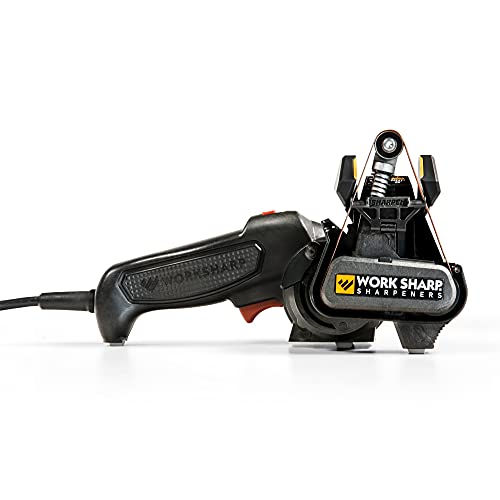
The MK2 Professional Electric Sharpener extends Work Sharp’s rugged performance to a broader set of blades and tools. Built for efficiency, it features a flexible belt system that conforms to blade edges, enabling rapid sharpening of outdoor tools, lawnmower blades, pocket knives, kitchen blades, and even serrated edges. The two-speed motor provides control for lighter touch-ups and heavier grinding tasks, while the edge guide supports blades all the way to the tip for consistent results. This model suits shops needing fast setup, repeatable edges, and compatibility with a wide blade range.
With a design oriented toward professional use, the MK2 emphasizes repeatability and ease of maintenance. Belts can be swapped quickly, reducing downtime between shifts, and the kit’s versatility supports a busy kitchen or workshop that regularly handles diverse edge tasks. While it excels with standard blades, serrated knives and tougher tasks benefit from the two-speed control, making it a practical choice for commercial environments that demand dependable performance across many knife types.
Chef’sChoice Professional Commercial Edge Select

Chef’sChoice Edge Select is a three-stage commercial electric sharpener designed to quickly deliver sharp, polished edges. It leverages 100-percent diamond abrasives for rapid material removal, paired with a dedicated 20-degree sharpening module that targets knives sized for professional use. The edge-select feature lets operators choose edge profiles based on the task, ensuring efficiency in high-demand kitchens. The rugged sharpening module is built for heavy workloads and can be detached for cleaning, which is advantageous in facilities with stringent sanitation requirements.
Edge Select emphasizes speed and edge quality, producing consistently sharp results suitable for professional kitchens that require dependable performance with minimal downtime. Its NSF-approved design adds a layer of confidence for food-service operations seeking equipment that meets industry hygiene standards. While it is highly capable for standard kitchen knives, its specific 20-degree module is best matched to blades designed for that geometry, providing a reliable, repeatable workflow in busy environments.
Waring Commercial Three-Station Knife Sharpener

Waring’s three-station commercial knife sharpener is built for heavy duty service in busy kitchens. The system features two grinding wheels and one stropping wheel, delivering both edge formation and polishing in a compact footprint. The stropping process can help remove burrs more efficiently, while the dual grinding wheels provide staged material removal for sharper results. A magnetized drawer beneath the grinding area collects metal shavings, simplifying cleanup after service. This model balances performance and sanitation, making it a practical option for commercial settings that rely on routine, high-volume sharpening.
For operations that prioritize ease of maintenance and predictable outputs, the Waring sharpener offers a straightforward workflow with minimal operator training. The ability to reverse the stropping wheel’s direction can enhance burr removal, contributing to cleaner edges with less downtime between shifts. While it may not offer the ultra-fine precision of some premium systems, its reliability and three-workflow design make it a solid choice for professional kitchens seeking a durable, NSF-friendly machine.
XARILK GEN3 Guided Knife Sharpening System
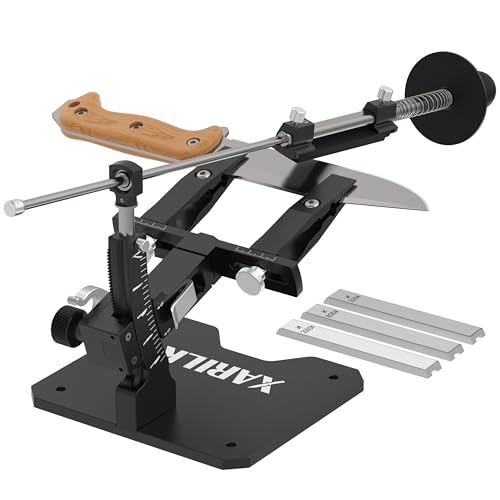
The XARILK GEN3 is a guided sharpening system built for precise, repeatable results across various knife types. It uses high-strength aluminum construction for durability and features three diamond plates (320, 800, and 2000 grit) to cover coarse reprofiling, fine sharpening, and ultra-polished edges. The precision-machined components ensure consistent results with each pass, while the included diamond plates offer long-lasting performance suitable for daily commercial use. The GEN3 design supports a broad range of blades, including kitchen, outdoor, folding, and hunting knives, making it a versatile option for pro kitchens and shops that require adaptable tooling.
In practice, the GEN3 system excels where operators prioritize control and edge consistency over high-speed belt grinding. Its guided approach reduces the chance of angle drift, which is valuable in busy environments that need dependable edges without extensive setup. While it may require some initial familiarization, the long-term benefits include minimal blade damage and uniform sharpening across a diverse blade collection commonly found in professional settings.
Buying Guide
- Sharpening method: Electric machines offer speed and consistency for high-volume tasks, while manual or guided systems give blade-by-blade control for specialized edges.
- Angle range and control: Look for adjustable angles (e.g., 15–30 degrees) and precise indicators to match blade type and use-case, including serrated knives.
- Abrasives and durability: Diamond abrasives last longer and cut faster than ceramic alone. Multi-stage systems with coarser to finer grits enable reprofiling and polish.
- Knife compatibility: Ensure the model robustly handles kitchen, hunting, serrated, and specialty blades common in commercial operations.
- Sanitation and maintenance: NSF-approved units or easy-clean designs reduce downtime and simplify sanitation, especially in food-service environments.
- Throughput and noise: Consider motor power, belt or wheel durability, and noise level for facilities with open kitchens or constant customer-facing activity.
- Portability vs. bench use: Decide between compact, portable models for small spaces and larger, fixed units for high-volume, constant operation.
- Maintenance schedule: Regularly inspect belts, abrasives, and wheels; replace worn components promptly to maintain edge quality and safety.
- Training needs: Choose models with straightforward setup and clear edge guides to minimize operator training time and errors.
- Cost of ownership: Initial price is important, but consider consumables (belts, plates) and replacement parts over the machine’s life.
- Edge goals: Define the intended edge geometry (food prep, slicing performance, or blade longevity) to select the appropriate stage configuration and grit range.