Best Dust Collection System for a Clean, Efficient Workshop
Choosing the right dust collection setup requires balancing airflow, filtration, scalability, and cost. Start by measuring your workspace and listing the tools that generate the most dust. Then assess whether you need a primary dust collector, supplementary air filtration, or both, plus the types of hoses and fittings that will connect your machines. The following considerations help compare the five featured products and identify a setup that fits your workflow.
| Product | Brand | Key Use |
|---|---|---|
| WEN DC1300 Dust Collector | WEN | 1,300 CFM, 50-Gal bag |
| DEWALT DWXAF101 Air Filtration System | DEWALT | 2-stage filtration, remote, timer |
| Cen-Tec 94698 Quick Click Hose Kit | Cen-Tec Systems | 10 ft hose, adapters |
| Qucship 4″ PVC Dust Hose | Qucship | Clear, puncture-resistant hose |
| POWERTEC 70306 Fittings Network | POWERTEC | Blast gates, splices, fittings |
WEN DC1300 1,300 CFM Dust Collector

This WEN DC1300 dust collector delivers up to 1,300 CFM of airflow, helping capture wood dust and chips at the source before they scatter through your shop. It supports two tools at once thanks to dual 4-inch inlets, making it versatile for multi-machine setups.
A vertical 50-gallon collection bag simplifies emptying during longer sessions, and the mobile base makes repositioning easy as your workspace changes. Powered by a 14-amp motor, this unit balances strong suction with a practical footprint for hobbyists and small shops alike. It is compatible with standard 4-inch dust hoses.
DEWALT DWXAF101 Air Filtration System
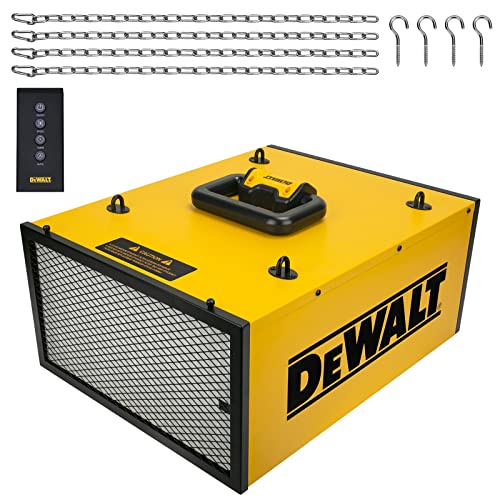
This DEWALT DWXAF101 air filtration system is designed to ceiling-mount, quietly improving workshop air quality without occupying floor space.
It combines a two-stage filtration system with a static cotton pre-filter and an H11 HEPA filter, capable of capturing over 95% of 0.3 μm particles. The unit includes timer settings for 1H, 2H, 4H, and 8H and a remote for convenient adjustments, while four operating modes—HI, MID, LO, and AUTO—adjust to changing dust loads and air quality.
Cen-Tec Systems 94698 Quick Click Hose Kit
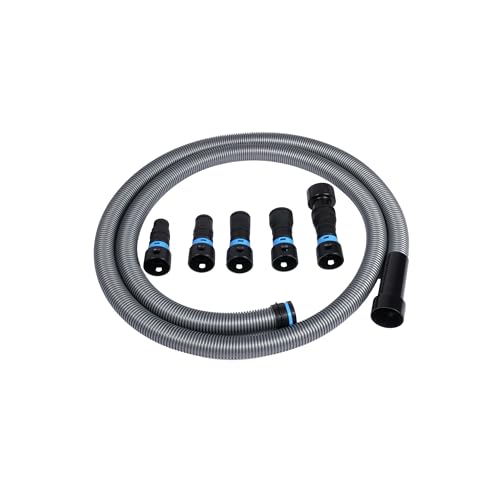
The Cen-Tec Systems 94698 Quick Click Hose Kit offers versatile connections for shop dust collectors. It includes a 1-1/4-inch diameter, 10-foot hose designed to connect to major brands, with adapters in 3/4, 1, 1-1/4, and 1-1/2 inch ports and a quick-click connection for fast tool changes.
Swivel bayonet fittings prevent kinking to maintain airflow. The kit’s flexible design supports a wide range of tools and vacuums, helping you keep a clean workflow when switching between stations.
Qucship 4-Inch Dust Collection Hose

Qucship’s 4-Inch Dust Collection Hose provides a clear and durable option for linking tools to your dust collector. The 4″ inner diameter and 10′ length balance reach with manageable weight, while thickened PVC resists punctures, and a carbon steel wire coil strengthens the hose for durability and safe grounding.
The transparent design lets you spot blockages early, helping you diagnose airflow issues before they affect suction. This hose is well suited for mid-sized workshop layouts where visibility and reliability matter.
POWERTEC 4 Inch Dust Collection Fittings Network

POWERTEC’s 4 Inch Dust Collection Fittings Network gives a modular spine for a shop with multiple machines. The kit includes five blast gates, one splice, four three-foot pipes, four Y-fittings, a 90-degree elbow, an assortment of mounting brackets, screws, and wall plugs, enabling flexible, friction-fit connections and quick layout changes without extra couplers.
The included clear pipes fit together with friction, which reduces setup time and supports easy reconfiguration as your shop evolves. This kit is ideal for builders who plan to expand their dust-collection network over time.
Buying Guide
Key Purchase Considerations
Choosing the right dust collection setup requires balancing airflow, filtration, scalability, and cost. Start by measuring your workspace and listing the tools that generate the most dust. Then assess whether you need a primary dust collector, supplementary air filtration, or both, plus the types of hoses and fittings that will connect your machines. The following considerations help compare the five featured products and identify a setup that fits your workflow.
- Airflow And Capacity: Select a unit with enough CFM for your shop size and the number of tools you run simultaneously.
- Filtration Type: 2-stage filtration with HEPA offers finer particle capture; consider a system with a pre-filter and washable components.
- Hose Diameter And Fittings: 4″ is a common standard; confirm compatibility with hoses and adapters for your machines.
- Expansion Potential: Look for modular components, additional ports, and compatible accessories to scale as your workshop grows.
- Mobility And Installation: Decide between portable carts, wheeled bases, or ceiling-mounted units based on space and workflow.
- Maintenance And Longevity: Plan for bag replacement, filter maintenance, and the cost of ongoing parts over the life of the system.
- Noise And Power: Check noise levels and motor amperage to balance comfort with performance.
System Configurations
Small hobby shops typically benefit from a single high-CFM dust collector like the WEN DC1300 as the core, with a few flexible hoses and a couple of blast gates to isolate active tools.
Medium to large shops or those with many tools benefit from layering a main collector with additional hoses and fittings that allow multiple machines to connect sequentially or in parallel. Pairing the DEWALT air filtration with the main collector provides improved air cleanliness without occupying valuable floor space.
Garage environments or spaces with limited ceiling height may prefer ceiling-mounted filtration and a compact collector, focusing on filtration efficiency during downtime.
Maintenance And Longevity
Regular maintenance includes bag disposal, filter cleaning or replacement, hose inspection for wear, and checking gaskets for leaks. For HEPA-equipped units, follow the manufacturer’s guidance on filter replacement. Keep blast gates closed when not in use to preserve suction at active stations. Periodic checks of duct connections and clamps help prevent leaks that reduce performance.
Cost Of Ownership And Warranty
Consider the total cost of ownership, including initial price, bags and filters, spare parts, and potential energy use. Look for supplier-backed warranties or service options to ensure parts availability over time. Balancing upfront investment with long-term maintenance costs helps identify the most cost-effective setup for your workshop.
Quick Setup Tips
- Place the main collector near the center of the shop to shorten hose runs.
- Route hoses with smooth bends to minimize resistance and clogs.
- Use blast gates to isolate inactive stations and optimize suction where you need it most.
- Keep filters clean and replace bags as recommended by the manufacturer.
- Ground hoses properly and consider anti-static measures for safety.
- Document your layout so you can reproduce a proven setup as you expand.
Product Comparison Snapshot
| Product | Main Use | Airflow / Capacity | Filtration / Connection | Notable Features |
|---|---|---|---|---|
| WEN DC1300 | Main Dust Collector | 1,300 CFM | Bagged collection; 4″ hoses | Mobile base; dual inlets |
| DEWALT DWXAF101 | Air Filtration | N/A | 2-stage; HEPA; remote | Ceiling-mount; timer |
| Cen-Tec 94698 Hose Kit | Hose Assembly | N/A | 10′ hose; multi-brand adapters | Quick Click; swivel fittings |
| Qucship 4″ PVC Hose | Hose Assembly | N/A | Clear; 4″ diameter; 10′ length | Puncture resistant; steel coil |
| POWERTEC 70306 Fittings | Fittings Network | N/A | Blast gates; splices; pipes | Modular; friction-fit |