Best Moisture Meter for Basement: Top Picks to Detect Leaks and Mold
Basement moisture can lead to unseen damage and mold growth. The right moisture meter helps you locate leaks, verify drying progress, and plan remediation. Below are five reliable options that balance accuracy, ease of use, and non-destructive testing for walls, floors, drywall, and concrete. Each selection includes practical features to support basements, crawl spaces, and storage areas across the United States.
Overview of chosen products:
| Product | Brand | Key Use | Type |
|---|---|---|---|
| General Tools MMD4E Digital Moisture Meter | General Tools | Moisture detection with audible alerts | Pin-type |
| Klein Tools ET140 Pinless Moisture Meter | KLEIN TOOLS | Non-destructive moisture detection | Pinless |
| RDINSCOS Pinless Moisture Meter for Wall, Floor | RDINSCOS | 3-color display, quick readings | Pinless |
| TopTes Wood Moisture Meter TS-630 | TOPTES | Wood and drywall readings, tri-color backlight | Pin-type |
| General Tools MMD7NP Digital Moisture Meter | General Tools | Non-invasive, deep readings | Pinless |
General Tools MMD4E Digital Moisture Meter
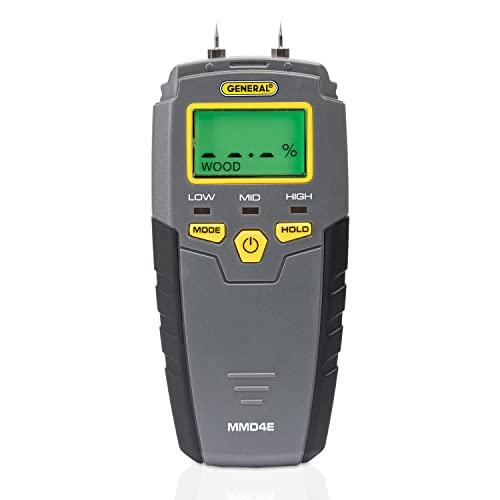
The General Tools MMD4E combines pin-type moisture detection with a backlit LCD display and audible alerts. It helps identify moisture levels that require remediation to prevent mold and mildew growth in basements. The device uses 8mm stainless steel pins for surface testing and includes a protective cap that doubles as a calibration checker. A reading HOLD button makes it easier to record measurements in damp or dim basement areas. This meter is suited for quick checks around water stains or suspected leaks in wood, drywall, and concrete surfaces.
Key features align with basement use: a clear visual display, audible alerts for high moisture, and robust pin probes for spot checks near foundation walls. It is a straightforward tool for homeowners and contractors to confirm whether remediation steps are necessary after a leak or flood event.
Klein Tools ET140 Pinless Moisture Meter

The Klein Tools ET140 provides non-destructive, pinless moisture detection suitable for drywall, wood, and masonry. Its non-invasive electromagnetic field (EMF) technology allows quick scans up to a 3/4-inch depth, which is ideal for assessing moisture behind basement walls or inside finished floors without leaving new holes. This meter is particularly helpful when evaluating potential water intrusion around basements where visual signs are limited. It also serves as a fast screening tool during home inspections or renovation planning.
Considerations for basement projects include the device’s quick reading capability, non-destructive approach, and its ability to cover typical basement materials. While pinless meters are convenient, users should interpret readings in the context of material type and density to avoid misreads in porous materials or thick concrete walls.
RDINSCOS Pinless Moisture Meter For Wall And Floor

This RDINSCOS meter uses advanced EMF technology for non-destructive moisture detection. It delivers fast, 3-color LCD readings that indicate dry, moderate, or wet conditions, with a simple hold feature to freeze readings for documentation. The device targets walls, floors, drywall, and concrete, making it a practical choice for basements undergoing inspections or renovations. Its emphasis on stability and ease of use helps property owners identify moisture problems before they escalate into costly repairs.
In basement contexts, stable readings across different spots are valuable to map moisture patterns and confirm dry-out progress after remediation. The meter’s instruction set guides users on optimal placement to minimize interference from metal studs or wiring, ensuring more reliable results on typical basement substrates.
TopTes Wood Moisture Meter TS-630

The TopTes TS-630 is designed for wood and drywall with a large 2.25-inch LCD and a tri-color backlight that clearly signals dry, moist, or wet conditions. It uses seven calibration scales and supports both wood and building materials, making it versatile for basements with wooden framing, drywall, or fireproofing layers. The device features a Date Hold and Max/Min function, enabling users to freeze and record readings over time, which is useful for monitoring progressive moisture changes after rain events or plumbing repairs.
For basement scenarios, the TS-630 provides intuitive visual cues and a reliable measurement range up to 57% moisture content in wood, with practical guidance for different materials. Users should note that higher-density materials or very dense wood may require longer measurement intervals for stable readings, and the meter should be used on multiple spots for a representative sample.
General Tools MMD7NP Digital Moisture Meter

The MMD7NP from General Tools offers pinless moisture detection with non-invasive operation and a deep testing capability. It reads moisture through surfaces up to 3/4 inch deep, covering wood, drywall, and masonry. The device emphasizes a broad measurement range for softwood and hardwood, with a 2-inch diagonal backlit LCD and a three-color LED bar graph. An audible alert complements the visual indicators to alert users to high moisture levels after basement inspections or remediation checks.
Basement workflows benefit from its pinless approach, which preserves finished surfaces while enabling quick scanning across large areas like basements or crawl spaces. The MMD7NP is suitable for ongoing monitoring after leaks or floods, though users should consider calibrating against known dry spots to ensure consistency across different materials and surface textures.
Buying Guide: Key Considerations For Basement Moisture Meters
- Pin Type vs Pinless: Pin meters provide direct moisture content at a pin insertion point, useful for spot checks in wood and drywall but leave small punctures. Pinless meters are non-destructive, ideal for large-area scans on walls, concrete, and floors, though readings can be influenced by surface material density and underlying layers.
- Measurement Depth and Range: For basements, look for devices that test at least up to 3/4 inch deep in common materials like drywall, plywood, and concrete. A wider range helps when comparing softwoods to dense masonry.
- Material Compatibility: Some meters calibrate for specific materials (wood, drywall, concrete). Choose those with multiple modes or scales to handle common basement substrates and avoid inaccurate readings caused by material variance.
- Display and Alerts: A backlit LCD, color-coded indicators (green/yellow/red), and audible alerts speed interpretation in dim basements and crawl spaces. Readings should be easy to record for documentation and insurance needs.
- Calibration and Maintenance: Look for models with simple calibration checks, protective caps, or calibration references. Regular recalibration improves accuracy after battery changes or tool reuse in harsh basement environments.
- Ease of Use and Data Logging: Devices with hold functions, data capture, and easy switching between materials reduce field time. For inspectors, a meter with consistent performance across spots minimizes the number of measurements required.
- Durability and Battery Life: Basements can be damp and dusty; choose rugged cases and long-lasting batteries to minimize downtime during inspections or repairs.
- Cost vs Benefit: Pinless meters are convenient for quick surveys and non-destructive testing, while pin-type meters may offer more precise readings at specific points. Consider the project scope when selecting a model.
These considerations help compare the five selections above. For broad basement use, pinless meters provide fast scans across walls and floors, while pin-type meters deliver precise local readings at critical points near suspected leaks. Integrating multiple meters or using a combination approach can improve overall moisture assessment and reduce repair costs over time.