Best Tools to Measure Angles for Carpentry and Precise Drafting
When carpentry hinges on precise angles, a reliable angle measuring tool becomes essential. This guide highlights top digital and contour gauges designed to improve accuracy, speed up work, and reduce guesswork on project sites. Each featured tool offers distinct advantages—from automatic on/off functionality to locking mechanisms and dual-scale readouts—making them suitable for DIY projects and professional jobs alike.
Summary of Selected Products:
| Product | Brand | Main Benefit | Notable Feature |
|---|---|---|---|
| Kirphealy Digital Angle Finder Protractor | Kirphealy | High-precision digital angles | 360° range, auto on, auto shut-off |
| JOREST Contour Gauge (10 Inch) with Lock | Jorest | Accurate shape duplication | Locking mechanism, dual scales |
| Digital Angle Finder Protractor (7″/200 mm) | TBVHOMM | Versatile digital and ruler combo | Locking, hold, upside-down reading |
| JOREST Contour Gauge with Lock (10 Inch) | Jorest | Profiling furniture and tiles | ABS build, dual scales |
| Multi Angle Measuring Ruler (12-Sided) | VINGAA | Flexible multi-angle drafting | 3-hole positioning, laser-etched scales |
Kirphealy Digital Angle Finder Protractor

The Kirphealy digital angle finder protractor is designed for carpentry and construction tasks that require precise angular readings. It offers a full 0–360° measuring range with an accuracy of ±0.3° and a resolution of 0.05°. The large display supports quick data reading, minimizing guesswork when marking cuts or aligning components. Auto power-on ensures seamless operation, while an automatic shut-off after six minutes helps conserve battery life on busy job sites. This tool is well-suited for corner fittings, miter cuts, and layout verification, delivering dependable results in both professional projects and home improvement tasks.
JOREST Connectable Contour Gauge (10+5 Inch)

The JOREST contour gauge provides versatile contour duplication with three usable sizes when combined: 5, 10, and 15 inches. It allows quick profiling of irregular shapes, which is useful for tile layouts, baseboard fitting, or trim work. The gauge features a double-sided metric and imperial scale, a slim blade with 0.05-inch thickness for accurate tracing, and a locking mechanism to hold your traced profile in place. This makes it convenient for transferring complex outlines to workpieces and ensuring precise cuts in woodworking and tiling projects.
Digital Angle Finder Protractor (TBVHOMM)
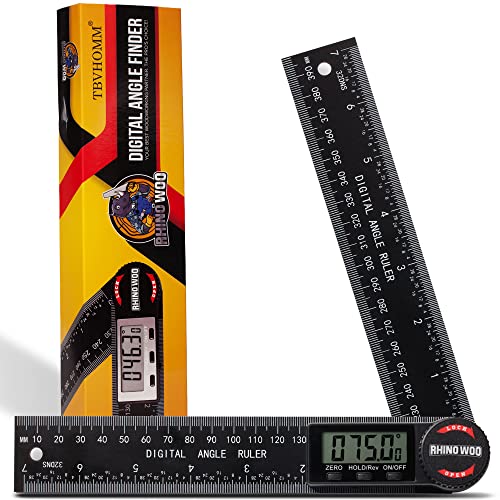
This digital protractor combines a high-contrast ruler with a digital readout to measure lengths and both internal and external angles. It supports a broad measurement range up to 999.9°, with an accuracy of ±0.3° and a resolution of 0.1°. Notable features include a locking knob to fix measurements, a hold function to preserve readings, and upside-down display capability for reverse measurements. The tool is suitable for woodworking, construction, and drafting tasks where flexible measurement control is needed, especially when measuring non-standard angles or angles in tight spaces.
JOREST Contour Gauge with Lock (10 Inch)

This contour gauge is built to profile complex shapes for tiles, carpet laying, woodwork, and molding projects. It features a dual-scale design in inches and centimeters, a robust 0.05-inch blade thickness for precise replication, and a locking mechanism to maintain contours during transfer. The tool’s ABS plastic construction is designed to withstand workshop conditions, offering reliable shape duplication for repeatable cuts and accurate layouts during renovations or new builds.
Multi Angle Measuring Ruler (12-Sided)
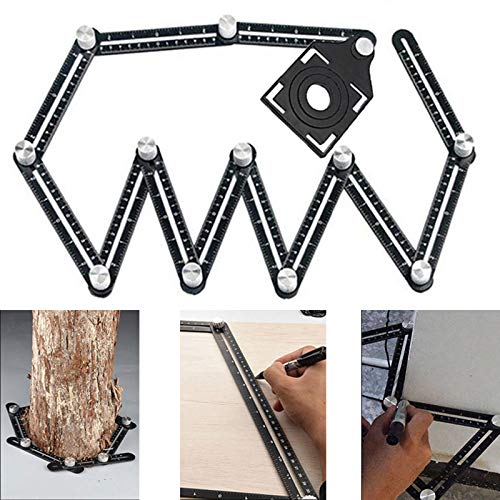
The 12-sided multi-angle measuring ruler from VINGAA provides CAD-like flexibility for drafting and quick layout work. It uses aluminum alloy, offering durability and resistance to wear. The ruler includes three positioning holes (45mm, 40mm, 25mm) and six adjustable knobs to shape and lock custom angles. A laser-engraved scale on both metric and imperial sides ensures long-lasting readability, making it ideal for tile layouts, trim work, and custom carpentry where precise angle replication matters.
Buying Guide: Key Purchase Considerations
- Measurement range and accuracy: Look for devices with wide angle ranges (0–360°) and precision within ±0.3° or better for professional accuracy in carpentry.
- Display and readability: Large LCD displays and clear readouts reduce misreads, especially in dim workshop environments. Consider hold and lock features to secure measurements.
- Build quality and durability: ABS plastic and metal constructions offer different durability profiles. For dusty or damp environments, choose corrosion-resistant materials and sealed electronics when possible.
- Locking mechanisms: A reliable lock helps transfer contours or hold a measured angle while marking or cutting, reducing errors during operation.
- Contour and profile capabilities: Contour gauges excel at duplicating irregular shapes for tiles, molding, and trim. Ensure the gauge teeth density and blade thickness enable precise tracing.
- Dual scales and readability: Dual-inch/centimeter scales simplify cross-referencing measurements across projects and across trades.
- Power features: Auto on/off, battery life, and power-saving modes impact convenience and uptime on site.
- Use-case alignment: For framing and cabinet work, digital protractors offer speed and accuracy; for tile and trim work, contour gauges provide best shape replication.
- Maintenance and calibration: Verify if the tool requires periodic calibration or battery replacements and consider models with straightforward maintenance.
Overall, selecting the right angle measuring tool depends on your typical tasks—whether you regularly draft layouts, duplicate irregular shapes, or verify angles across multiple pieces. A combination of a digital protractor for quick readings and a contour gauge for copying complex profiles covers the most common carpentry scenarios without sacrificing accuracy.