Best Dust Collectors for Garage Projects
Finding the right dust collector for a garage workshop depends on air flow, debris capacity, compatibility with tools, and ease of setup. The following selections are organized to help American hobbyists and professionals compare features, filtration efficiency, and portability. Each model below is designed to reduce dust while keeping your shop vacuum and tools running efficiently. Read through the options to identify the best fit for your space, workflow, and maintenance preferences.
| Product | Brand | Key Benefit | Distance to Suction Needs |
|---|---|---|---|
| Mullet High-Speed Cyclone Dust Collector | Mullet | Pre-separator and airtight PVC connection | Great for shop vac integration |
| WEN DC1300 1300 CFM | WEN | High air volume with 50-gallon bag | Versatile for multiple tools |
| DEWALT DXVCS003 | DEWALT | 99.5% debris capture with cyclone design | Excellent lifelong filter protection |
| DEWALT DXVCS002 | DEWALT | High-efficiency separator with wide compatibility | Adaptable for many vacuums |
| WEN DC3474 | WEN | Moderate motor with wall-mount option | Compact and space-saving |
The following sections detail five solid choices for garage workshops, including setup notes and what to expect in daily use.
Mullet High-Speed Cyclone Dust Collector For Shop Vacuum
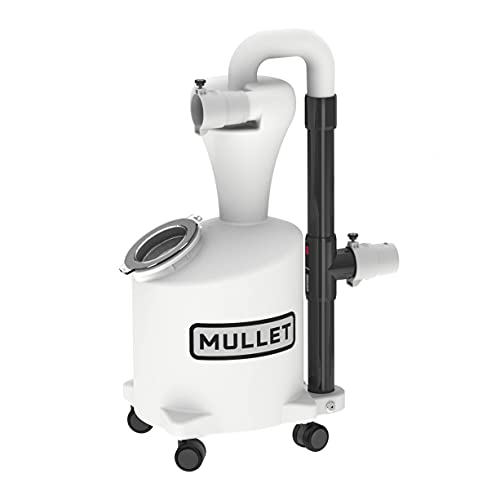
The Mullet cyclone design pre-separates more than 99% of debris before air reaches the shop vac or dust extractor. This preserves suction and reduces filter clogging, helping your vacuum run more consistently. A parabolic, one-piece construction accelerates the airstream for improved capture efficiency, while the rigid, cut-to-fit PVC connection simplifies installation and creates an airtight seal. This model emphasizes compatibility with standard shop vacs, reducing maintenance and improving overall dust control in woodworking spaces.
WEN DC1300 1,300 CFM Dust Collector

The WEN DC1300 delivers high-volume air movement, circulating up to 1,300 cubic feet per minute. It supports dual inlets, allowing you to attach multiple tools at once, and it includes a 50-gallon collection bag for substantial debris capacity. A mobile base enhances portability, making it suitable for a garage where tool setups frequently change. This model is ideal for woodworkers who need significant suction power for mid-sized workshops without sacrificing mobility.
WEN Woodworking Dust Collector, 7.4-Amp

Powered by a 7.4-amp induction motor and a 9-inch impeller, this WEN unit moves up to 600 CFM. A 4-inch dust port enables connection to your favorite woodworking tools, while the wall-mount capability adds versatility in tight spaces. The compact design and mobile base support easy repositioning as your shop layout evolves, making it a practical choice for smaller garages or dedicated hobby rooms.
DEWALT Dust Separator With 10 Gal Stainless Tank

DEWALT’s 99.5% efficient cyclone separator protects the fan and filters by pre-separating debris before it enters the vacuum. The 10-gallon stainless tank provides ample collection capacity and an adaptable design suitable for various shop vacs. With ports compatible with common hoses and a stable base, this separator is designed for long runs with varied materials, from wood dust to drywall and concrete debris.
DEWALT Dust Separator with 6 Gallon Poly Tank

This DEWALT model features a 99.5% efficient cyclone system with a compact 6-gallon poly tank. It supports common port sizes (1-7/8″ and 2-1/2″) for broad compatibility with many vacuums and tools. The four-caster base ensures mobility within the workshop, and the design facilitates easy emptying and maintenance, making it a practical upgrade for hobbyists seeking reliable dust separation without sacrificing space.
POWERTEC AF4000 3-Speed Remote Filtration System

The POWERTEC AF4000 provides three speed options (300, 350, or 400 CFM) with remote control and dual-filter setup (5-micron outer and 1-micron inner). This system focuses on airborne particulates rather than dust collection from a shop vacuum, making it a complementary solution for improving overall air quality in a garage workshop. It’s especially useful when you want to reduce fine dust while other collection methods handle bulk debris.
Buying Guide: Dust Collectors for Garage Use
Key considerations help determine the best fit for a garage workshop. First, evaluate airflow capacity (CFM) relative to the tools you use and the space available. Higher CFM is beneficial for multiple tools running simultaneously, but it may come with larger footprint and noise considerations. Second, look at filtration and debris separation efficiency. Cyclone separators that capture up to 99.5% of debris protect vacuum motors and extend filter life. Third, assess compatibility with existing tools and hose sizes. Ports that support common diameters (4 inches, 1-7/8 inches, 2-1/2 inches) offer flexible integration with saws, sanders, and sandblasters. Fourth, consider mobility and space: mobile bases and wall-mount options save floor space in tight garages. Fifth, maintenance needs matter. Units with easy-empty tanks and straightforward filter replacement reduce downtime. Finally, safety features such as circuit breakers, auto shutoff timers, and sturdy bases help prevent unexpected operation issues. For comprehensive setups, pairing a cyclone separator with a filtration system can yield cleaner air and longer tool life, especially in tightly sealed garages. Compare models by CFM, tank or bag capacity, ease of installation, and whether the unit is designed to handle wet, dry, or mixed debris.