Best Table Saw Blade for Melamine: Smooth, Precise Crosscuts Every Time
Melamine and veneered laminates demand blades that cut cleanly with minimal chipping. This guide highlights high-performance blades designed for table saws that consistently deliver finish-quality edges on melamine, plywood, and related materials. Each blade below features advanced carbide formulations and geometry optimized for crosscuts, making them ideal for cabinetmaking, fineline joinery, and finish carpentry. Explore top options, compare their builds, and learn how to choose the right blade for your melamine projects.
| Product | Brand | Notes |
|---|---|---|
| LU79R010 Ultimate Plywood & Melamine Blade | Freud | Hi-ATB, TiCo carbide blend, clean crosscuts |
| D0860X Fine Finish Blade | Diablo | Hi-Density carbide, non-stick coating |
| P10080 Melamine & Ultra Finish Blade | CMT Orange Tools | 10″ x 80T, ITK melamine cuts |
| LU80R010 Ultimate Plywood & Melamine Blade | Freud | Hi-ATB, TiCo carbide, splinter-free cuts |
| DWA11080 Fine Finish Blade | DEWALT | Ultras sharp carbide, low vibration |
Freud LU79R010 Ultimate Plywood & Melamine Blade

Designed for flawless finish cuts, the LU79R010 excels at veneered plywood, melamine, laminates, and crosscuts in solid woods. Its premium TiCo carbide blend delivers extended edge retention and lasting performance, while the Hi-ATB tooth geometry provides superior shearing action for clean, polished edges. This blade is an excellent option for finish carpentry and cabinetmaking where edge quality matters most.
Diablo D0860X Fine Finish Blade
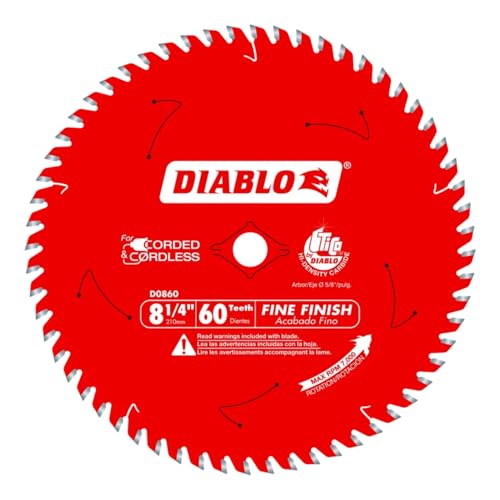
The Diablo D0860X offers TiCo Hi-Density carbide teeth for precise, chip-free cuts in wood, plywood, and melamine. The Hi-ATB tooth grind ensures smooth rip and crosscuts across various materials, while the Perma-Shield non-stick coating resists heat, gumming, and corrosion. This blade emphasizes consistent finish quality and extended blade life, making it well-suited for workshops focusing on fine finish work.
CMT P10080 Melamine & Ultra Finish Blade

This 10″ blade from CMT ITK line is tailored for crosscuts and fine finishes on two-sided laminates, including melamine, without requiring a scoring blade. The 0.094 kerf and 0.063 plate thickness contribute to efficient cutting with reduced waste. The 10° hook angle supports controlled entry and helps minimize chipping on delicate surfaces, making it a practical choice for precise cabinet assembly and veneer work.
Freud LU80R010 Ultimate Plywood & Melamine Blade

The LU80R010 shares the same purpose as the LU79R010 but offers its own configuration optimized for high-ATB cuts. With 80 teeth and a TiCo Hi-Density carbide blend, this blade delivers splinter-free crosscuts, particularly on melamine and plywood. Its design supports smooth edges in cabinetry and finish work, reducing post-cut sanding requirements and improving productivity on finish runs.
DEWALT Table Saw Blade, 10 Inch, 80 Tooth

The DEWALT DWA11080 blade emphasizes extended life and improved finish quality through a patented body slot design that reduces vibration and improves accuracy. Its 80-tooth configuration is optimized for fine finishes on melamine and plywood, while its blade geometry aims to deliver cleaner cuts with less chatter. This blade suits shop environments prioritizing consistent surface quality and reduced post-cut cleanup.
Buying Guide: Melamine Table Saw Blade Considerations
When selecting a melamine-capable blade, consider tooth geometry, carbide grade, kerf width, and coating. A Hi-ATB or ATB grind helps minimize tear-out on delicate laminates by providing a clean shear cut. TiCo or similar high-density carbide blends improve edge retention and overall durability for repeated crosscuts in thin laminates. A fine kerf typically reduces waste and demands less power, which is beneficial for compact, hobby, or portable table saws. Coatings such as non-stick or anti-heat treatments help maintain clean cuts in melamine’s resin-rich surfaces.
Balance is key: blades with more teeth can yield smoother finishes on melamine but may cut slower in dense cores. For cabinet-grade work, blades with 60–80 teeth generally offer a good mix of speed and surface quality. If you cut thick laminates or need aggressive offset tolerance, consider a blade with larger plate thickness and a robust carbide mixture to resist chipping.
Usage context matters: for precision finish carpentry, a dedicated melamine blade with a thin kerf and anti-chip tooth geometry can minimize edge defects. For production environments, a blade with durable non-stick coatings and extended life through carbide optimization supports longer run times between sharpening. Always match arbor size, tooth count, and overall blade diameter to your table saw’s specifications to ensure safe and effective operation.
Summary and best practices:
- Choose a blade with Hi-ATB or ATB geometry for clean melamine edges.
- Prefer TiCo or comparable carbide blends for durability and edge retention.
- Opt for 60–80 teeth on 10″ blades for a balance of finish quality and crosscut efficiency.
- Consider non-stick or anti-heat coatings to extend blade life on resin-rich laminates.
- Ensure proper feed rates and support to minimize chipping and splintering.