Best Air Nailer for Framing: Top 5 Framing Nailers for Pros and DIY
Choosing the right air nailer for framing can boost productivity, reduce fatigue, and improve overall project quality. This guide highlights five top-rated framing nailers designed for flooring, roof decking, and building framing projects. Each product is evaluated on weight, versatility, and reliability, helping homeowners and professionals compare options quickly. Read on to see which model best fits your workload, whether you’re tackling subflooring, wall sheathing, or truss assembly.
| Product | Brand | Model |
|---|---|---|
| Metabo HPT NR90AES1 | Metabo HPT | 21° Plastic Collated Framing Nailer |
| BOSTITCH F21PL | Bostitch | Framing Nailer |
| NuMax SFR2190 | NuMax | 21° Framing Nailer |
| Metabo HPT NR83A5 | Metabo HPT | 21° Framing Nailer |
| Paslode 501000 PowerMaster | Paslode | Pneumatic Framing Nailer |
The following sections profile each model, focusing on key capabilities, typical applications, and notable design elements that affect day-to-day use.
Metabo HPT NR90AES1 Framing Nailer

This 21-degree plastic collated framing nailer is designed for high-load framing tasks, including flooring, roof decking, and wall assemblies. Weighing about 7.5 pounds, it offers a well-balanced profile to reduce user fatigue during extended sessions. The tool is suited for applications like subflooring, truss build-up, and housing construction, delivering dependable drive force while maintaining maneuverability.
BOSTITCH F21PL Framing Nailer

Two-in-one versatility defines this model with quick-change nosepieces enabling framing or metal connector work. Its patented depth guide allows precise nail seating, making it adaptable for various framing scenarios. The lightweight magnesium body balances durability with comfortable handling during long framing sessions or trim work that follows heavy building tasks.
NuMax SFR2190 Pneumatic 21 Degree Framing Nailer

Designed for framing, subfloors, roof decking, and fencing, this 21-degree tool accepts plastic-collated nails from 2″ to 3-1/2″ in length. Its one-piece hardened steel drive blade contributes to robust durability, making it suitable for job sites with repetitive nailing tasks and extended use in wood-heavy constructions.
Metabo HPT NR83A5 Framing Nailer

Powered by a cylinder valve drive mechanism, this 21-degree model delivers rapid driving performance for framing, flooring, and deck projects. It features a selectable trigger mode to switch between sequential or contact nailing, enabling quick adaptation to varying framing sequences and reducing overall firing time on larger builds. The tool has earned recognition as a Pro Preferred option for its reliability and performance in professional settings.
Paslode Pneumatic Framing Nailer 501000 PowerMaster
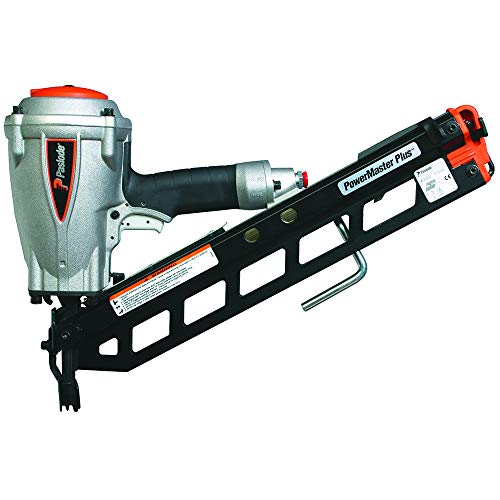
Paslode emphasizes maneuverability with low recoil and a center-of-gravity close to the trigger, enhancing balance and reducing arm fatigue. It delivers strong performance for framing walls, even in harder woods, and its compact form fits between standard 16″ on-center studs, joists, and rafters. The design aims to minimize jams and misfires during demanding framing chores.
Metabo HPT NR90ADS1 Framing Nailer

This NR90ADS1 model is designed to cover framing, flooring, and truss build-up, featuring a lightweight 7-pound body for extended use. It includes selective actuation for quick switching between sequential and contact nailing. The design prioritizes balance and user comfort, supporting sustained productivity on large framing jobs and deck installations.
Buying Guide: Key Factors For Choosing An Air Nailer For Framing
Framing projects demand power, reliability, and efficiency. Consider these factors when selecting an air nailer for framing tasks:
- Angle and nail gauge: 21-degree and 30-degree options cover most framing jobs. Ensure compatibility with common nail lengths (2″–3-1/2″ or 3-1/4″ ranges) and head type (full round head or plastic collated) for strong, secure fastenings.
- Weight and ergonomics: Lighter tools reduce fatigue during long days on the job site. Balance and grip design influence comfort and control while driving nails overhead or in tight spaces.
- Trigger options: Selectable triggers (sequential vs. contact) speed up complex assemblies and reduce misfires. This is especially helpful when working on walls or roof decking where rapid firing is beneficial.
- Durability and drive power: Look for hardened drive blades and robust construction to resist wear in demanding framing environments. A tool with a reliable power mechanism is critical for consistent nail depth and minimal jams.
- Maintenance and accessories: Availability of nosepieces, depth adjustments, and lube requirements affects long-term upkeep. Consider models that offer easy access to parts and common replacements.
- Overall kit and compatibility: Many framing nailers ship with additional accessories or are part of a system (nails, tips, and maintenance kits). Compatibility with existing compressors and hose lengths is also important for a seamless workflow.
How to choose between models can depend on your typical workload. For frequent framing and subflooring, a lightweight, high-reliability tool with selectable actuation helps maintain momentum. For occasional framing or mixed-use projects (decking, roofing), a versatile nailer with multiple modes and durable construction provides flexibility. Safety features, such as balanced exhaust direction and jam prevention, add value on busy sites. Reading reviews about real-world performance can offer additional clarity beyond specifications.