Best Circular Saw Blades for Paneling and Plywood Projects
Choosing the right circular saw blade can dramatically improve paneling, plywood, or OSB work. The blades below are tailored for clean edges, durability, and efficient cutting on paneling and vinyl siding. This guide compares five top options from trusted brands to help you pick the best blade for precise, smooth results.
| Product | Brand | Teeth | Arbor | Kerf |
|---|---|---|---|---|
| CRAFTSMAN 7-1/4 Inch 140T Fine Finish | CRAFTSMAN | 140 | 5/8 in | 0.059 in |
| 3Pack 5-1/2 Inch 130T | Janchi | 130 | 5/8 in | 0.062 in |
| DEWALT 6-1/2 Inch 90T | DEWALT | 90 | 5/8 in | 0.059 in |
| FOXBC 6-1/2 Inch 90T | FOXBC | 90 | 5/8 in | 0.083 in |
| CRALY 6-1/2 Inch 140T | CRALY | 140 | 5/8 in | 0.079 in |
The table above highlights blades that excel at paneling and veneer work, balancing tooth count, kerf, and durability. Below, five selected blades are examined in detail, with attention to how their features translate to real-world paneling performance.
CRAFTSMAN 7-1/4 Inch 140T Fine Finish Blade

This 7-1/4 inch blade is designed for paneling and plywood with a fine finish. The fully hardened plate helps maintain true cuts over time, while precision-ground teeth deliver smooth, accurate results. The high-carbon steel construction enhances blade life for repeated project use, making it a reliable choice for finish-grade paneling and OSB work where clean edges matter.
Janchi 3Pack 5-1/2 Inch 130T Blade

The Janchi 3-pack offers an economical option for paneling tasks, featuring 130 teeth for smooth, precise cuts with a thinner kerf. The tougher alloy steel construction helps blades stay sharper longer, reducing the frequency of blade changes during plywood, OSB, or vinyl siding installations. Ideal for fast, clean cuts on multiple panels.
DEWALT 6-1/2 Inch 90T Blade

DEWALT’s blade employs tungsten carbide for longer edge retention and a friction-reducing coating that minimizes gum-up. The 90-tooth configuration is designed for plywood and paneling where fast, smooth cuts are essential. A thin kerf supports quick passes with reduced resistance, helping you complete installations efficiently while maintaining edge quality on paneling and veneers.
FOXBC 6-1/2 Inch 90T Blade

This FOXBC blade is a 6-1/2 inch option with 90 teeth and a 5/8 inch arbor. It is marketed as versatile for paneling, vinyl siding, plywood, and OSB, with a focus on fast, smooth cutting. The 0.08″ kerf supports efficient performance for cross cuts and miter cuts, helping minimize splinters and edge chipping on veneers and paneling faces.
CRALY 6-1/2 Inch 140T Blade

The CRALY blade features a 140-tooth configuration with a 5/8 inch arbor and a narrow kerf. High-hardness steel teeth offer durability for repeated paneling, OSB, and veneer cuts, while a relatively thin kerf minimizes waste and battery draw. This blade is positioned for finish-quality edges on plywood and paneling projects that require precise, clean lines.
FOXBC 5-1/2 Inch 130T Blade

This 5-1/2 inch FOXBC blade comes in a 3-pack with 130 teeth and a 5/8 inch arbor, plus versatile bushings. It targets smooth, splinter-free cuts across plywood, OSB, paneling, and vinyl siding. The combination of tooth count and kerf supports high-quality cross cuts and long edge life for repeated paneling sessions.
FOXBC 7-1/4 Inch 140T Blade
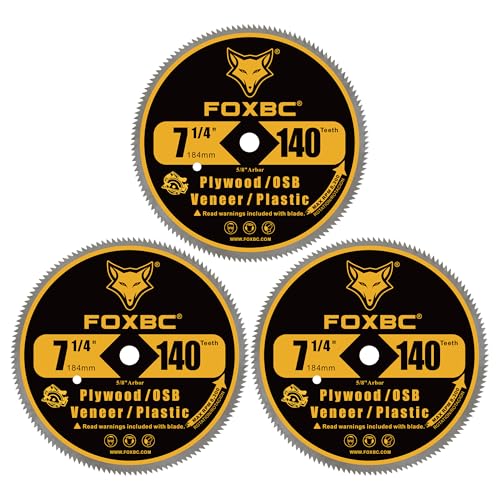
The FOXBC 7-1/4 inch blade uses 140 teeth and a 5/8 inch arbor for fine, finish-oriented cuts on plywood, OSB, plastic panels, and vinyl siding. A 0.086″ kerf reduces waste and keeps edges smooth, making it a strong choice for carpentry work that calls for precise paneling joints and minimal tear-out along the grain.
FOXBC 5 3/8 Inch 78T Blade

Designed as a replacement for DeWalt DW9053 sets, this 5 3/8 inch blade uses 78 teeth for fast, efficient cross-cutting of paneling and plastics. The 3/8 inch arbor makes it compatible with many saws, while the blade’s construction emphasizes quick removal of material with good edge quality for paneling and veneer work.
Buying Guide: Key Considerations For Paneling Or Plywood Projects
- Tooth count and tooth geometry: Higher tooth counts (e.g., 140T) yield smoother finishes on faces and edges, especially for paneling and veneers. Lower tooth counts tend to cut faster but leave rougher edges.
- Kerf thickness: Thin-kerf blades reduce resistance, require less power, and minimize material waste. For portable saws, a thinner kerf often translates to less motor strain and cleaner cuts with paneling.
- Arbor compatibility: Most paneling blades use a 5/8 inch arbor. Check your saw’s arbor size and ensure compatibility with required bushings when needed.
- Material suitability: Blades labeled for plywood, OSB, vinyl siding, or plastics should deliver clean edges and resist chipping on soft substrates common in interior paneling.
- Durability and coatings: Carbide-tipped teeth and anti-stick coatings help sustain blade life and reduce friction during long cuts, minimizing gum-up on vinyl and adhesive-heavy panels.
- Finish quality vs. speed: For finish-grade paneling, opt for blades marketed as fine finish or finish-cutting. For rough framing or rapid paneling installs, a blade with a balance of speed and edge quality may be preferred.
- Budget vs. reuse: A 3-pack provides value for jobs with many repeats, while a premium single blade may deliver longer life per cut in dense materials.
When selecting a blade, consider your primary material mix (plywood, OSB, vinyl siding, plastics) and your saw’s power. For frequent paneling work requiring clean faces, blades with 140 teeth and thin kerfs offer a strong balance of finish quality and ease of cutting. For fast paneling with less emphasis on the final surface, 90T blades may suffice, especially when paired with smooth cutting coatings to minimize gum-up.