Best Digital Angle Finder for Table Saw
The right digital angle finder can improve accuracy and speed in table saw setups, miter cuts, and other woodworking tasks. This guide reviews five highly capable models, highlighting accuracy, magnetic bases, readability, and additional features like backlighting and auto-inversion. Use the buying tips below to compare options and choose the tool best suited to your shop workflow.
| Product | Brand | Key Feature |
|---|---|---|
| POWERTEC 71828 | POWERTEC | ±0.2° accuracy, strong magnetic base |
| Huepar Digital Angle Finder | Huepar | ±0.1° accuracy, 0-180° modes, VA LCD |
| RDINSCOS Digital Angle Finder | RDINSCOS | Auto-rotation, backlight, magnet base |
| Klein Tools 935DGGP | KLEIN TOOLS | Flexible conversions, high visibility |
| S&F STEAD & FAST Digital Gauge | S&F STEAD & FAST | Backlit, 4*90° range, durable |
These selections emphasize reliability in wood shops, with magnetic bases for hands-free work, clear displays for quick readings, and durable housings to withstand workshop conditions.
POWERTEC 71828 Digital Angle Finder Pro

The POWERTEC 71828 provides precise digital angle measurement with a reported accuracy of ±0.2° and a finer ±0.1° at 0° and 90°, along with a 0.05° resolution. It covers a measuring range of 4×90°, making it suitable for aligning miters and bevels on table saws. A magnetic base enables hands-free use by attaching to ferrous surfaces, including blade housings and fence assemblies. The device ships with a sturdy nylon case to protect it during transport and storage. This model emphasizes reliability and straightforward operation for routine woodworking tasks.
Pros include high accuracy in common table saw angles, a stable magnetic base, and a compact form factor that fits into typical shop workflows. A potential consideration is the need for battery installation, as listed with the note that batteries are not included. Overall, the POWERTEC unit is well-suited for hobbyist to project-level shops seeking consistent angle readings during setup and cut marking.
COROLLATA Digital Angle Finder With Laser
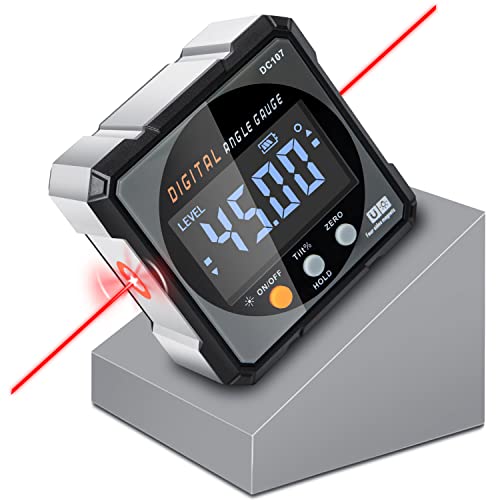
The COROLLATA model combines a digital angle finder with an electronic laser reference and a four-sided magnet setup for secure attachment. It delivers precise ±0.2° control over 0–90° angles, with zeroing capability at any angle for quick comparison between settings. The integrated laser helps verify alignment on longer runs or across extended work surfaces, while the magnetized body aids stable positioning on metal surfaces. This tool is well-suited for tasks that benefit from a laser-assisted layout alongside digital readouts.
Considerations for this unit include ensuring you have a safe calibration routine and managing the laser’s visibility in bright shop environments. A dual-purpose tool like this can save time when performing repetitive setups, especially where alignment across multiple components is necessary. As with all digital angle finders, maintain battery health and store properly to preserve magnet strength and display clarity.
Huepar Digital Angle Finder Magnetic Version

Huepar’s digital angle finder is designed for high-precision woodworking and metalworking applications, offering a claimed accuracy of ±0.1° at 0°/90° and ±0.2° elsewhere. It supports 0–90° and 0–180° modes, with multiple measurement units (degrees, percent, mm/m, in/ft) and both absolute and relative readings. The strong magnetic base facilitates hands-free operation on saw blades and other ferromagnetic surfaces. A special feature is its calibration-friendly design and a robust LCD display for clear visibility in busy shop environments.
Strengths of this model include excellent accuracy, flexible measurement modes, and solid magnetic attachment. It’s a good pick for professionals who need dependable angle readouts across a range of construction and woodworking tasks. Be mindful of battery maintenance and calibration intervals to preserve peak performance over time.
RDINSCOS Digital Angle Finder Magnetic Box

The RDINSCOS unit emphasizes auto-rotation and a backlit display for easy use in dim conditions. Its V-Groove magnetic base helps secure the tool to curved or straight metal surfaces, facilitating measurements on table saws and jigs. The device is described as portable and lightweight, making it convenient for use with other measuring tools in tight workspaces. Its design focuses on practicality for woodworking and metalworking tasks where quick angle checks are needed.
Practical benefits include a readable backlit display, reliable magnetism, and a compact footprint. The model is suitable for hobbyists who value a straightforward, dependable angle measurement tool without requiring complex calibration. As with any magnetic gauge, ensure the surface is ferromagnetic and free of debris to maximize accuracy.
Klein Tools 935DGGP Digital Angle Finder

The Klein Tools 935DGGP offers flexible unit conversions, allowing quick transitions between degrees, percent grade, in/ft, and mm/m. It doubles as a digital level and can measure absolute or relative angles. A high-contrast display improves visibility in low-light environments, aiding quick and accurate setup of bevels and saw fence alignments. The tool is designed for versatility across framing, landscaping, and general carpentry tasks, with a focus on intuitive operation and dependable performance in busy workshops.
Key considerations for this model include ensuring you’re comfortable with unit conversions on the fly and leveraging its digital level capabilities for multi-angle projects. The display readability and conversion options help reduce misreads, but users should verify calibration periodically to maintain accuracy across tasks.
S&F STEAD & FAST Digital Angle Finder Gauge

This model from S&F Stead & FAST emphasizes a backlit LCD display for reading measurements in dark work areas and a self-inverting display for slope readings when the tool is upside down. It provides a range of 4×90°, with accuracy around ±0.2°, repeatability ±0.1°, and resolution ±0.05°. A robust aluminum frame adds durability for frequent handling and transportation. The device is magnetic, compact, and lightweight, making it a practical addition to a woodworking kit where frequent angle checks are required.
Consider this option for projects that demand a clear, backlit readout and strong magnetism. The aluminum construction helps withstand the occasional bump in a busy shop. Users should confirm that the magnet size suits their specific mounting surfaces and consider battery management for extended use in professional settings.
Buying Guide: Key Purchase Considerations
- Accuracy and range: Look for ±0.1° to ±0.2° accuracy and a broad range like 0–180° to cover most table saw tasks.
- Magnetic base: A strong magnetic base lets you attach the tool to blades, fences, or metal surfaces, enabling hands-free measurements and safer operation.
- Display readability: Backlit LCD or VA displays improve readability in dim shops; self-inverting displays help when the tool is inverted.
- Calibration and units: Favor models with easy calibration procedures and multiple units (degrees, percent, mm/m, in/ft) for versatility.
- Durability and portability: Aluminum or rugged housings, compact form factors, and protective carrying cases extend tool life in a shop setting.
- Additional features: Lasers, auto-rotation, and relative/absolute readings can add value depending on your workflow. Consider whether you need these extras for efficiency.
- Battery considerations: Most digital angle finders require battery power; check battery type, availability, and expected life to avoid downtime.
- Use case alignment: For table saw setups, prioritize stable magnetic mounting, clear display, and quick zeroing for repeated bevels and miters.
In practice, selecting a digital angle finder for a table saw revolves around balancing precision with ease of use. If you frequently perform miters and bevel cuts, a device with a high-contrast display, reliable magnetic hold, and rapid zeroing will yield the most consistent results. For projects requiring alignment across multiple surfaces, models with absolute/relative readings and multiple unit conversions can save time and reduce measurement errors. Evaluating the build quality and protection against dust and moisture also helps ensure long-term reliability in woodworking shops.